
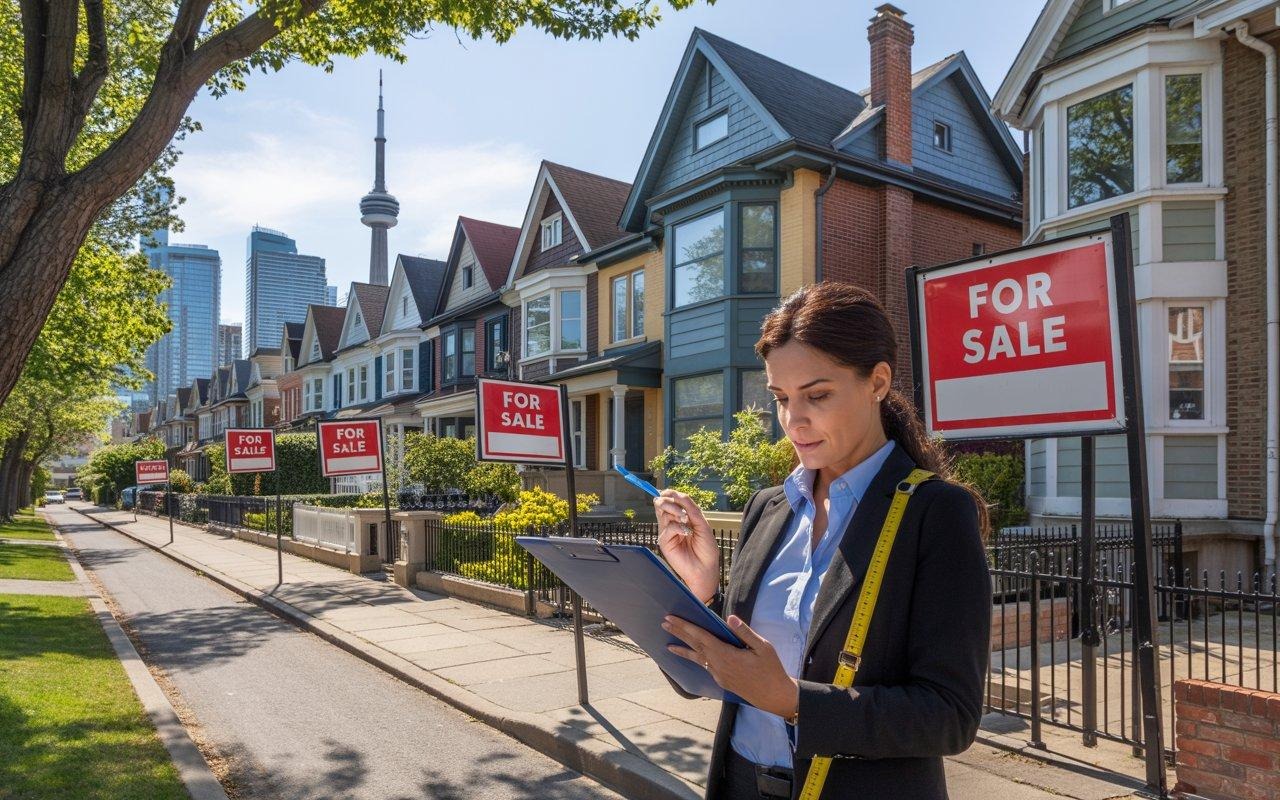
My neighbour cornered me at the coffee shop last Tuesday, practically vibrating with excitement. She’d found a semi-detached in Leslieville listed at $899,000. “It’s got to be worth at least a million-two,” she said, already mentally picking out paint colours. “I’m going in at $950K tonight before someone else grabs it.”
I didn’t have the heart to tell her right there that she was walking into the oldest pricing game in Toronto real estate. Last I heard, that house sold for $1.34 million after a bidding war with seventeen offers. She didn’t get it, obviously. And the person who did paid about $90,000 more than they needed to because they got caught up in the frenzy.
This is the Toronto housing market in a nutshell right now. Properties listed suspiciously low, buyers convinced they’ve found a unicorn, and by offer night, everyone’s shocked at how much over asking it went. I’ve been doing home appraisals across this city for fifteen years, and I can tell you—this pricing game isn’t going anywhere. But you don’t have to be a victim of it.
Why Toronto Sellers Underprice on Purpose
Let’s start with the uncomfortable truth: when you see a house in Toronto listed well below what you think it’s worth, it’s not a mistake. It’s not a desperate seller who needs to move fast. It’s strategy.
Here’s how it works. A listing agent looks at comparable sales in High Park and sees that similar three-bedroom homes have been selling for $1.4 to $1.5 million. Instead of listing at $1.45 million and hoping for the best, they list at $1.199 million—sometimes even lower, like $1.099 million.
Why? Because at $1.45 million, you’re fishing in a smaller pool of buyers. At $1.199 million? You just opened the floodgates to everyone who set their online search filter to “under $1.2 million.” Suddenly you’ve got buyers stretching their budget, investors running numbers, and people who weren’t even looking in that neighbourhood showing up to viewings.
I watched this play out on a house in East York last month. Listed at $749,000. Comparable sales in that pocket were running $880,000 to $920,000. The listing agent knew exactly what they were doing. By offer night, they had twenty-three registered offers. It sold for $967,000.
The buyers who got it? They thought they won. They beat twenty-two other people, after all. But here’s what kills me—an accurate home appraisal would have told them that house was worth about $895,000. They overpaid by seventy-two thousand dollars because they got sucked into the psychology of the bidding war.
The Emotional Trap (And Why Smart Buyers Avoid It)
I need you to understand something about how your brain works when you’re house hunting in Toronto. You see a property listed below market value, you go to the showing, and there are twelve other groups walking through. The agent mentions they’ve already had tons of interest. Offer night is Wednesday at 7 PM.
What happens in your head? Scarcity kicks in. Competition anxiety. You start thinking about all the other houses you’ve lost. You tell yourself you’re not going to let this one slip away. By the time Wednesday rolls around, you’re not thinking rationally anymore—you’re thinking emotionally.
And that’s exactly what the pricing strategy is designed to do.
I had a client last year, first-time buyer looking in the Junction. Sweet kid, young couple expecting their first baby. They found a house listed at $899,000 and fell in love. They asked me to do an appraisal before offer night, which honestly made my whole week because most people don’t think to do this.
The appraisal came back at $1.03 million. I explained that based on recent comparable sales, condition of the property, and the specific location within the Junction, that’s what a willing buyer should expect to pay a willing seller in a normal transaction. Not in a panic. Not in a bidding war. Just a fair market value.
They went in at $1.04 million on offer night. They didn’t get it—someone else paid $1.16 million. But you know what? They didn’t care. They knew they’d stuck to their number, and they weren’t going to let ego or competition push them into overpaying by $130,000. Two weeks later, they found another house, paid $1.02 million, and actually got a better lot.
What a Real Appraisal Actually Tells You
Here’s where I need to get a bit technical, but stay with me because this is important.
When I do a home appraisal in Toronto, I’m not just looking at listing prices. Listing prices are fiction—they’re marketing. I’m looking at what homes actually sold for, and then I’m adjusting for all the differences between those homes and the one you’re thinking about buying.
Let’s say you’re looking at a three-bedroom, two-bath house in the Beaches listed at $1.199 million. I’m going to pull comparable sales from the past three to six months within about a half-kilometer radius. I’ll find maybe five or six houses that sold in similar condition, similar size, similar lot.
Then comes the detailed work. Is your house on a busier street? That’s a downward adjustment. Does it have a finished basement when the comparables didn’t? That’s an upward adjustment. Better kitchen? Older roof? Closer to the subway? Further from good schools? Every single variable gets factored in.
What you end up with is a number that reflects what this specific house should actually sell for in a normal market transaction. Not a fantasy number. Not a bidding war number. A real number.
And here’s the thing—sometimes that number is higher than the list price, which means it might actually be worth getting into a reasonable bidding situation. But more often, especially in this market, the appraisal reveals that the listing price is bait, and the actual value is maybe 8% to 15% higher than asking.
The Seller Side of This Game
I should mention this isn’t just a buyer problem. I work with sellers too, and I’ve seen plenty of them get burned by bad pricing advice.
A couple in Riverdale called me last spring. They wanted to sell, and their agent suggested listing at $1.149 million to “generate buzz” when the house was really worth about $1.38 million. The idea was to create a bidding war and maybe push it to $1.45 million.
I walked them through the risk: what if you only get two offers? What if the market softens that week? What if buyers are getting smarter about these tactics and they start walking away from obvious pricing games?
They decided to list at $1.349 million instead—just under the appraised value. It sold in nine days for $1.37 million to a buyer who didn’t have to compete with fifteen other people and genuinely wanted the house. The sellers got full value, the buyers felt good about the price, and nobody wasted emotional energy on game-playing.
That’s not the Toronto way right now, I know. But it’s worth thinking about.
How to Use an Appraisal When You’re Buying
If you’re serious about buying a home in Toronto—and by serious, I mean you’re ready to write offers and you’re not just casually browsing—here’s what I’d recommend:
When you find a house you really like, especially one that’s listed suspiciously below what you think it should be, order a professional appraisal before offer night. Yes, it’ll cost you somewhere between $400 and $700 depending on the property. And yes, if you don’t end up buying that specific house, you’re out that money.
But think about what you’re getting: a clear-eyed, professional opinion of what that house is actually worth, completely removed from the emotional chaos of a bidding war. It becomes your anchor point. Your reality check.
I work with investors and regular buyers through Innovative Property Solutions, and the ones who consistently make smart purchases are the ones who know their numbers before they walk into the offer room. They don’t get swept up in the competition. They don’t panic. They have a maximum price based on actual value, and they stick to it.
Sometimes they lose properties because someone else is willing to overpay. That’s fine. There’s always another house. What they never do is win a house and then realize three months later that they’re underwater because they paid $150,000 over market value in the heat of the moment.
The Real Price Isn’t Always the Sale Price
Here’s my final thought, and it’s something I wish more Toronto buyers understood: the price a house sells for and the price a house is worth aren’t always the same thing.
In a hot bidding war, houses regularly sell for 10%, 15%, sometimes 20% over their actual market value. That’s not a reflection of value—that’s a reflection of competition and emotion and scarcity psychology.
If you’re buying a home to live in for the next fifteen years, maybe that doesn’t matter much. You’ll ride out the market cycles. But if you’re stretching your budget, or if you might need to sell in the next five years, or if you’re treating this as an investment, overpaying is a real problem.
A professional home appraisal gives you the truth before you commit. It’s not exciting. It’s not sexy. It doesn’t help you “win” the bidding war. But it does help you make a decision you won’t regret when the adrenaline wears off and you’re sitting at the lawyer’s office signing mortgage documents.
And in Toronto’s wild housing market, that might be the most valuable information you can have.
