
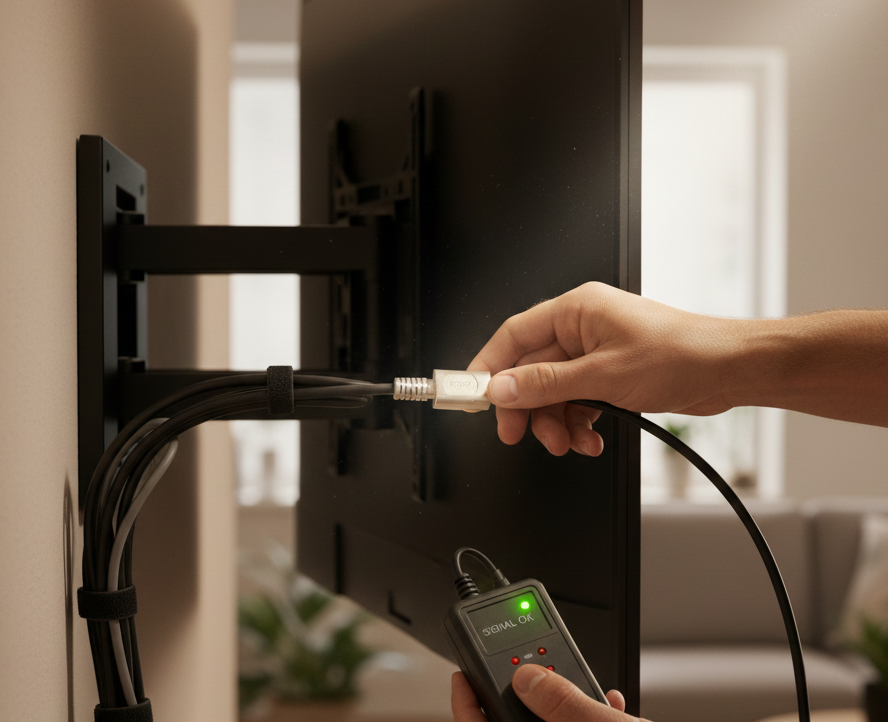
Picture flickering. Sound cutting out mid-scene. A TV that flat-out refuses to power on. Every one of those symptoms can trace back to a single overlooked culprit — the cables bunched behind your set. Most people blame the television itself, which is understandable. But cable damage ranks among the most common, and most consistently underestimated, sources of TV trouble. Knowing how it works can save you real money and a mountain of pointless frustration.
What Happens When Cables Deteriorate
Think of cables as plumbing for your TV’s signals and power. Both matter enormously. Cuts, kinks, or frayed jackets let electromagnetic interference bleed straight into the signal path — even a hairline breach in the outer shielding is enough to cause chaos. Electrical noise floods the data stream and corrupts whatever’s traveling through it. Physical stress, UV exposure, extreme heat or cold — all of it gnaws at the protective materials over time. The signal your TV was expecting? It arrives garbled, or not at all.
Which symptoms you end up with depends on which cable failed and how badly. A partially damaged HDMI cable might throw random pixel errors — brief, blink-and-you’ll-miss-it glitches. Severe damage is different. It can wipe out an entire color channel, leaving the image tinted or completely washed out. Internal wire breaks inside power cables create inconsistent electrical flow — and that’s what triggers those maddening intermittent shutdowns.
Impact on Picture Quality
Clean picture quality demands a clean signal. Full stop. Damaged video cables introduce noise and loss that degrade the image in ways you’ll definitely notice. Pixelation — those ugly scattered blocks across the screen — is one tell. Ghosting is another, where faint echoes of moving objects trail behind the real thing. Color banding and sudden hue shifts happen when the cable can no longer faithfully carry color data.
Sometimes damaged cables produce no image whatsoever. The signal degrades past a threshold. The TV can’t decode the incoming data anymore. You’re left staring at a black screen despite the set being fully powered up. Coaxial cables — the kind used for cable TV or satellite — are especially vulnerable to this; once shielding fails, interference floods in and the tuner simply loses its lock. Users assume the TV is dead. In reality? A five-dollar replacement cable would’ve fixed it in minutes.
Audio Trouble Linked to Cable Damage
Audio cables carry sound from your cable box, streaming stick, or antenna to the speakers. Damage hits them hard. Static, crackling, a persistent low hum sitting under everything you watch — classic signs, every one of them. Some damaged cables produce intermittent dropout, where audio vanishes for a few seconds then snaps back, almost like the TV is catching its breath.
Diagnosis can get genuinely tricky. Digital audio cables — optical or coaxial connections — can fail completely from a single sharp bend or a loose connector. Just one. Analog cables with compromised shielding pick up AC hum from nearby power sources; that low-frequency drone becomes a permanent fixture. More devices sharing your TV means more potential offenders. And in configurations where a connecting hub is involved, the problem can run deeper than the cable itself. When the One Connect cable linking a Samsung TV to its hub sustains damage and swapping the cable alone doesn’t resolve things, technicians performing samsung one connect box repair can determine whether the box itself was compromised by the faulty connection.
Power Cable Concerns and Safety
Power cables deserve at least as much scrutiny as signal cables. More, arguably. Frayed insulation isn’t just a performance issue — it’s a genuine safety hazard. Exposed wiring risks electrical shock on contact, and a damaged cable near the outlet, where current draw peaks, raises real fire risk. Don’t patch it with electrical tape. That fix doesn’t restore the cable’s safety rating. It just creates a false sense of security.
Beyond the obvious safety angle, damaged power cables undermine TV performance in subtle, maddening ways. Internal wire breaks add resistance. That resistance starves your television of consistent power. Unexpected shutdowns, unreliable power-on behavior, brightness that fluctuates for no apparent reason — all of it points here. Some users notice the TV runs fine for the first hour, then cuts off spontaneously. Classic signature of a power cable with damaged internal conductors. Swap it for a manufacturer-approved replacement and both the performance problem and the hazard vanish at once.
How to Identify Damaged Cables
Routine inspection catches problems early. Look for cuts, burns, kinks, or any stretch of insulation that’s cracked or missing. Run your fingers along the full length of each cable; bend it gently — stiff spots or jacket cracks are red flags. Check both connectors for bent pins, corrosion, or looseness. Some damage hides entirely inside the cable. If visual inspection turns up nothing but problems persist, swap suspect cables out one at a time against known-good replacements to isolate the fault.
Focus on high-stress locations: cables running over hot surfaces, pinched under furniture legs, or crossing paths where people walk regularly. Those spots deteriorate fastest. Cables near heating vents or radiators suffer accelerated heat damage. And cables that regularly coil into tight loops? The copper conductors inside eventually fatigue and fracture at the bends. The resulting faults feel completely random — until you work through each cable methodically.
Conclusion
Damaged cables produce a surprisingly wide spectrum of TV problems — from a faint picture glitch all the way to complete signal loss and genuine fire risk. Understanding the mechanisms helps you troubleshoot faster and skip unnecessary repair bills. Inspect cables regularly. Replace damaged ones promptly. Route them carefully to minimize physical stress. Next time your TV misbehaves, spend a few minutes checking every cable before you conclude the set itself is broken. More often than you’d expect, one simple swap brings everything back to life.
