
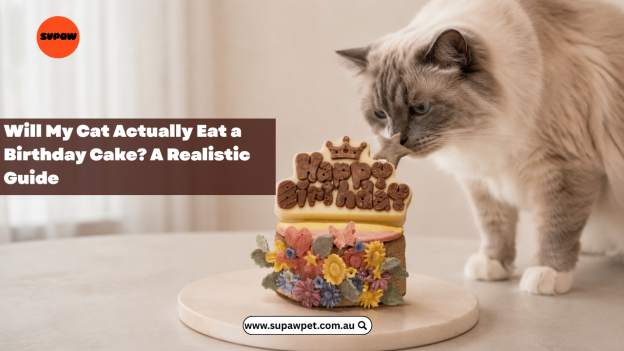
You order a lovely cake for your cat’s big day, then watch them sniff it and walk away. It happens more often than you might expect, and there is a good reason behind it. Before you plan a cat’s birthday cake celebration, it helps to set realistic expectations.
This guide explains how cats actually respond to cake and why.
Cats Are Not Like Dogs at Mealtime
Dogs tend to dive into food with pure enthusiasm, while cats take a more measured approach. Your cat may circle a cake, sniff it carefully, and decide in their own time. This caution is completely normal and part of their nature.
Cats are naturally selective about what they eat, which serves them well in the wild. They judge food by smell, texture, and taste before committing to a bite. So when you offer a cat birthday cake, do not be surprised by a slow, careful response.
Why cats approach food cautiously:
- They rely heavily on smell before tasting anything
- They are sensitive to unfamiliar textures
- They prefer food that matches their carnivorous instincts
- They simply like to take their time
Patience is key here, since a cautious cat is not a rejecting cat.
Cats Cannot Taste Sweetness at All
Here is a fascinating fact that explains a lot about cats and cake. Cats cannot taste sweetness, because they lack the receptor needed to detect it. This is not a preference but a hard-wired part of their biology.
Researchers confirmed this in a well-known study. According to a PLOS Genetics study, cats possess a functional sense of taste, yet they do not prefer or may be unable to detect the sweetness of sugars. In simple terms, a sweet cake holds no appeal for a cat.
This is exactly why a pet-safe cat cake is never made sweet. Instead, it is built around savoury, meaty flavours that cats actually enjoy. Understanding this helps you choose a cake your cat is far more likely to eat.
Meat Is the Way to a Cat’s Heart
Since sweetness means nothing to cats, flavour has to come from elsewhere. Cats are drawn to the savoury, umami taste of meat above all else. A cake built using meat protein speaks their language perfectly.
A well-made cat cake uses real animal protein as its foundation. Chicken, tuna, and ocean fish are the flavours that genuinely tempt a cat. These proteins smell appealing and match what a cat’s body craves.
Flavours cats actually respond to:
- Chicken as a familiar, well-loved protein
- Tuna for its strong, tempting aroma
- Ocean fish for a savoury, meaty appeal
Choosing a cake with these flavours gives your cat every reason to tuck in.
Smell Matters More Than Looks
To us, a beautifully decorated cake is the star of the party. To your cat, however, the smell is what truly counts. Cats lead with their nose, so aroma decides whether they investigate further.
A cake with a strong, meaty scent is far more inviting to a cat. However, presentation still matters to you for photos and memories. Just remember that your cat judges the birthday cake for cat by nose first, not by sight.
How to Help Your Cat Enjoy Their Cake
A few simple tricks can turn a hesitant cat into a happy one. These small steps give your cat the best chance of enjoying their treat. None of them take much effort at all.
Start by offering a small piece rather than the whole cake at once. Hand-feeding the first bite can also encourage a nervous cat.
Simple ways to encourage your cat:
- Offer a small piece by hand first
- Serve it in a calm, quiet space
- Let your cat approach it in their own time
If your cat still prefers to nibble slowly, that is perfectly fine. Every cat enjoys things in their own way.
Managing Your Expectations
Some cats will happily eat their cake, while others may only have a taste. Both reactions are completely normal, so try not to feel disappointed. The celebration is about love and attention, not a clean plate.
Even a curious sniff and a small bite is a lovely moment. Your cat feels the care behind the day, regardless of how much they eat. What matters most is that you celebrated your cat birthday with something special.
If your cat leaves some cake, you can save it for later. A small portion the next day often gets a warmer welcome.
Celebrate Your Cat, Their Way
Your cat may not devour their cake the way a dog would, and that is okay. Choosing a savoury, meat-based cake gives them the best chance of enjoying it. Add a little patience, and the day becomes special for both of you.
Supaw’s cat cakes are made with human-grade chicken, tuna, and ocean fish, crafted for a cat’s real tastes. Browse the full cat range at supawpet.com.au, call 03 9043 2534, or visit the store at 364 Spencer St, West Melbourne.
Frequently Asked Questions
Will my cat actually eat a birthday cake?
Some cats eat their cake happily, while others only have a small taste. A savoury, meat-based cake gives your cat the best chance of enjoying it, so choose flavours like chicken or fish.
Do cats like cake?
Cats do not respond to cake the way dogs do, mainly because they cannot taste sweetness. They are far more likely to enjoy a savoury cake made with real animal protein.
Can cats eat cake safely?
Yes, as long as the cake is made specifically for cats with safe ingredients. Avoid human cakes entirely, since sugar and other ingredients are unsuitable for a cat’s body.
Why are cats fussy about cake?
Cats are naturally selective and judge food by smell and texture first. They also cannot taste sweetness, so a sweet cake holds no appeal for them at all.
