
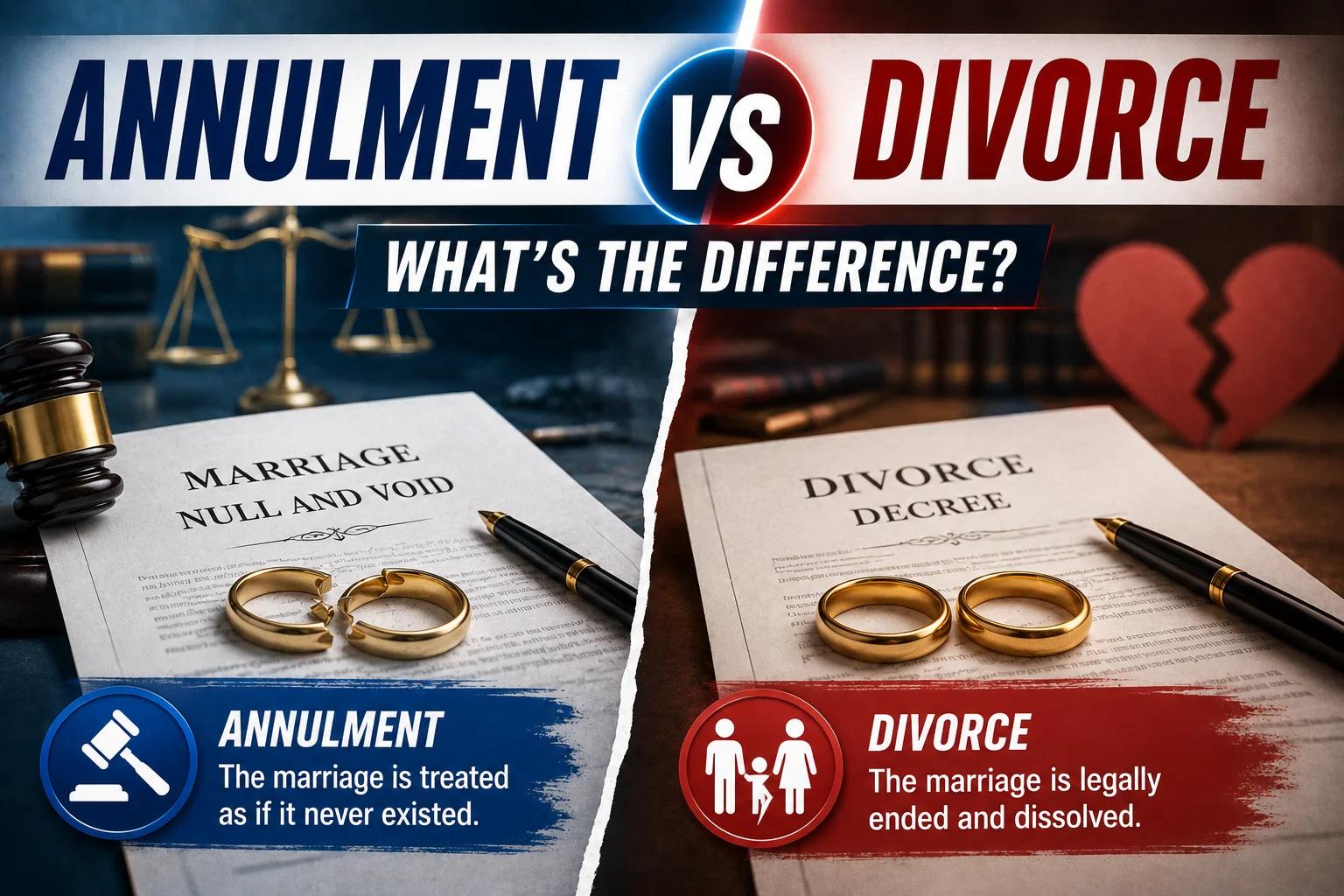
Annulment vs divorce can be confusing because both procedures end a marital relationship. The key difference is that divorce ends a legally valid marriage, while annulment declares that the marriage was legally invalid.
Annulment is usually available only in specific circumstances, while divorce is generally easier to obtain. The exact rules depend on the state or country where the case is filed.
What Is An Annulment?
How Does An Annulment Work?
An annulment is a legal process that declares a marriage invalid. It is generally based on a problem that existed when the marriage began.
Depending on local law, the issue may involve fraud, coercion, bigamy, incest, age, or lack of legal capacity. The person seeking annulment usually has to establish a recognized legal ground.
An annulment is not simply a quicker version of divorce. It has a different legal purpose and is generally harder to obtain.
What Does An Annulment Mean Legally?
When an annulment is granted, the marriage is treated as invalid under the applicable law. This differs from divorce, where the court accepts that a valid marriage existed and then terminates it.
Some marriages are considered void from the beginning. Others are considered voidable, meaning they remain legally recognized unless a court declares them invalid.
The distinction can affect the rights of both spouses. It can also affect property, financial support, and other legal matters.
Is An Annulment The Same As Erasing A Marriage?
No. An annulment does not necessarily erase every record that the marriage occurred.
Government records can continue to show the marriage and the later annulment. The legal effect concerns the validity of the marriage rather than physically deleting historical records.
This is one reason the phrase “the marriage never existed” can be misleading. It describes the legal effect in certain respects, rather than deleting every record of the relationship.
What Is A Divorce?
Divorce is the legal termination of a valid marriage. The court recognizes that the marriage existed and issues an order ending the marital relationship.
A divorce can address several matters between the spouses. These can include property, debts, spousal support, child custody, visitation, and child support.
The process can be uncontested or contested. An uncontested case may be relatively straightforward, while disagreements can make the process longer.
What Are The Grounds For Divorce?
Most U.S. states allow some form of no-fault divorce. This means a spouse can seek a divorce without proving that the other spouse committed misconduct.
Common terms include irreconcilable differences and an irretrievable breakdown of the marriage. Some states also permit fault-based divorces under specific circumstances.
Fault grounds can include adultery, abandonment, cruelty, and other legally recognized conduct. The available grounds vary by jurisdiction.
Why Is Divorce More Common?
Divorce generally has broader eligibility requirements than annulment. A person does not normally need to prove that the marriage was invalid from the beginning.
This makes divorce available in situations where a marriage has simply broken down. It can also provide established procedures for dividing property and handling financial responsibilities.
A short marriage does not automatically qualify for annulment. If no valid annulment ground exists, divorce may be the appropriate legal process.
Annulment Vs Divorce: Main Difference
Legal Status Of The Marriage
The biggest difference concerns how the law views the marriage. Divorce recognizes a valid marriage and legally ends it.
Annulment, by contrast, establishes that the marriage was invalid under applicable law. The legal effect can reach back to the beginning of the marriage.
This distinction explains why the two procedures have different eligibility requirements. An annulment focuses on a problem affecting the validity of the marriage itself.
Grounds And Eligibility
Annulment usually requires a specific legal ground. Examples can include fraud, coercion, bigamy, incest, underage marriage, or certain forms of incapacity.
Divorce usually does not require proof that the marriage was invalid. In a no-fault divorce, the spouse generally states that the marriage has broken down.
Because of this difference, divorce is normally available to a wider range of couples. Annulment is limited to situations recognized by local law.
Legal Result
A completed divorce ends the parties’ legal marriage. Both people can generally remarry once the divorce becomes final and any applicable requirements are satisfied.
An annulment results in a legal declaration that the marriage was invalid. The exact consequences depend on whether the marriage was void or voidable under local law.
Neither procedure should be confused with informal separation. Living apart does not necessarily change a person’s legal marital status.
Grounds For Annulment
Fraud Or Misrepresentation
Fraud is one of the commonly recognized grounds for an annulment. The deception generally needs to involve an important matter that affected a person’s decision to marry.
Not every lie between spouses qualifies. The legal standard depends on the jurisdiction and the facts of the case.
Examples discussed in legal resources can include hiding an existing marriage or significant facts about circumstances that were important to the decision to marry. A court determines whether the specific conduct meets the legal standard.
Duress Or Coercion
A marriage may qualify for annulment when consent was obtained through force or serious coercion. The basic issue is whether the person freely agreed to the marriage.
The required level of coercion differs between jurisdictions. Evidence may be needed to establish what happened before or during the marriage.
This ground focuses on the validity of consent. If a person was pressured into marriage under circumstances recognized by local law, annulment may be possible.
Bigamy, Incest, Or Age
Some marriages are legally invalid because they violate basic requirements for marriage. Bigamy is a common example when a person enters another marriage while already legally married.
Incestuous marriages can also be prohibited by law. Likewise, a marriage involving a person below the legal marriage age can sometimes qualify for annulment.
The rules are not identical everywhere. Anyone considering annulment should check the law that applies to the marriage.
Annulment Vs Divorce: Property And Money
How Is Property Handled In Divorce?
Divorce generally provides a legal process for dealing with marital property and debts. Depending on the state, property may be divided under community property or equitable distribution rules.
The court can also address financial obligations between the spouses. This can include responsibility for certain debts and other marital expenses.
The exact rules vary by location. Property acquired before and during the marriage can be treated differently under state law.
How Is Property Handled After Annulment?
Property issues can be more complicated after an annulment. Since the marriage is declared invalid, ordinary marital-property rules may not apply in exactly the same manner.
Courts may still have ways to address property acquired during the relationship. The available remedies depend on local law and the circumstances.
This does not mean that one spouse automatically keeps everything. Property disputes can still require legal proceedings.
What About Spousal Support?
Divorce can allow a court to award spousal support when the legal requirements are met. Factors can include income, financial need, marriage duration, and other considerations established by local law.
Annulment can produce different results because the marriage is treated as legally invalid. Spousal support may be limited or unavailable in some jurisdictions.
The exact result depends on the applicable law. Anyone relying on support should obtain advice based on their specific situation.
Annulment Vs Divorce: Children
Does Annulment Affect Children?
An annulment does not remove a child’s legal rights. Children can still have rights involving financial support, custody, inheritance, and other matters.
The fact that a marriage is declared invalid does not eliminate parental responsibilities. Courts can still establish appropriate arrangements for the children.
This is an important distinction because some people assume annulment makes the entire family relationship legally disappear. It does not.
What Happens To Child Support?
Child support can still apply after an annulment. Parents generally remain responsible for supporting their children regardless of the marital status between the adults.
The court can establish support based on applicable child-support laws. Income, custody arrangements, and other required factors may be considered.
Divorce proceedings can also establish child support. The child’s financial rights are separate from the question of whether the parents remain married.
What Happens To Child Custody?
Custody arrangements can still be established after an annulment. Courts generally focus on the child’s welfare when determining custody and parenting arrangements.
Parents may receive legal and physical custody rights according to local law. Parenting time and decision-making responsibilities can also be addressed.
Divorce cases involving children follow similar principles. The end of the marriage does not end either parent’s responsibilities.
Annulment Vs Divorce: Process And Cost
Which Process Is Easier?
Divorce is generally easier to obtain because no-fault divorce does not require proving that the marriage was invalid. A spouse can usually rely on the legal grounds available in the relevant jurisdiction.
Annulment requires a qualifying circumstance. Evidence may be necessary to establish that the marriage should be declared invalid.
This can make an annulment more difficult when the other spouse challenges the claim. A divorce may be more straightforward when both parties agree to end the marriage.
Which Is Faster?
Neither procedure has one universal timeline. Court schedules, waiting periods, paperwork, disputes, and local requirements can all affect the duration.
An uncontested case can move faster than a disputed case. An annulment can also take longer when the parties disagree about whether a valid ground exists.
People should therefore avoid assuming that annulment is automatically faster. The actual timeline depends on the jurisdiction and circumstances.
Which Costs More?
Costs vary according to location and case complexity. Court fees, attorney fees, hearings, evidence, property disputes, and child-related issues can all affect the final cost.
A simple uncontested divorce may be relatively affordable. An annulment involving disputed evidence can become expensive if the case requires extensive legal work.
There is no universal rule that annulment costs less than divorce. Comparing the likely procedures in the applicable jurisdiction gives a more useful estimate.
Civil Annulment Vs Religious Annulment

What Is A Civil Annulment?
A civil annulment is a legal ruling that affects marital status under civil law. It is handled through the appropriate court or legal authority.
The court considers whether the marriage meets the legal requirements for annulment. If the requirements are satisfied, the court issues the appropriate order.
A civil annulment therefore has legal consequences under the applicable government system. It is different from a religious declaration concerning a marriage.
What Is A Religious Annulment?
A religious annulment is a decision made under the rules of a religious institution. Its purpose and requirements depend on the particular faith tradition.
A religious annulment does not necessarily change a person’s civil marital status. Someone may need a civil divorce even if their religious institution grants an annulment.
The two processes can therefore exist separately. People should not assume that completing one automatically completes the other.
What Is A Catholic Annulment?
The Catholic Church uses the term declaration of nullity for its annulment process. It examines whether a valid marriage existed under Catholic canon law.
This process is not simply a religious version of civil divorce. A declaration of nullity does not mean that the church considers a valid marriage to have been ended by the procedure.
Civil marital status remains a separate legal matter. A person may therefore need to address both civil and religious requirements.
Annulment Vs Divorce And Personal Records
Does Divorce Stay On Your Record?
A divorce can remain part of official court and government records. The final divorce order provides legal evidence that the marriage was terminated.
The exact accessibility of these records varies by jurisdiction. Some records may be publicly accessible, while others may have restrictions.
Divorce can also affect documents involving taxes, insurance, benefits, property, and other financial matters.
Does Annulment Stay On Your Record?
An annulment can also remain documented in official records. The legal proceeding does not necessarily disappear simply because the marriage was declared invalid.
The record can show that a marriage occurred and that a court later granted an annulment. Therefore, annulment should not be understood as complete deletion of the marriage history.
The effect on future paperwork depends on the particular agency or institution. Different organizations can have their own documentation requirements.
Annulment Vs Divorce: Quick Comparison
Side-By-Side Comparison
| Feature | Annulment | Divorce |
| Basic purpose | Declares a marriage legally invalid | Ends a valid marriage |
| Marriage status | Treated as invalid under applicable law | Recognized as valid before termination |
| Eligibility | Limited legal grounds | Generally broader |
| No-fault option | Usually not | Available in every U.S. state in some form |
| Fraud | Can be a ground | May be relevant in some cases |
| Coercion | Can be a ground | May affect other legal issues |
| Bigamy | Can make a marriage void | Not generally needed as a divorce ground |
| Property | Rules vary | Marital-property rules generally apply |
| Spousal support | May be limited | May be available |
| Child support | Can still apply | Can apply |
| Child custody | Can still be decided | Can be decided |
| Official records | May remain documented | Divorce remains documented |
| Remarriage | Generally possible after final order | Generally possible after final order |
| Religious process | Separate from civil law | Separate from civil law |
These are broad U.S. principles. State laws can differ significantly, particularly regarding annulment grounds and financial consequences.
Related Comparisons And Life Decisions
Legal Decisions Can Have Different Consequences
Choosing between legal options often requires looking beyond the basic definition. For example, the difference between annulment and divorce concerns the legal status of a marriage, while other family-law choices can involve completely different issues.
Financial programs can also have different eligibility rules and purposes. This is similar to understanding the difference between SSI and SSDI, where two programs may appear similar but operate under different requirements.
Why Comparing Similar Terms Helps
Many everyday searches involve two things that sound similar but serve different purposes. The same idea applies to travel planning, where understanding the difference between Disneyland and Disney World can help people choose the experience that fits their plans.
The key is to identify what each option actually does. Once the purpose, eligibility, cost, and practical effects are clear, the comparison becomes much easier.
Look At The Details Before Deciding
A simple label does not always tell the full story. Legal and financial choices can depend on location, eligibility, timing, and personal circumstances.
For annulment and divorce, jurisdiction is especially important. A rule that applies in one state may not apply in another.
That is why general information should not replace advice based on the applicable law. A qualified family-law professional can explain how the rules apply to a specific situation.
FAQs
What Is The Main Difference Between Annulment And Divorce?
Divorce ends a legally valid marriage, while annulment declares that the marriage was legally invalid under applicable law. Annulment generally requires a specific legal ground.
Is Annulment Better Than Divorce?
Not necessarily. Annulment is only available when specific legal requirements are satisfied, while divorce is generally available more broadly.
Can A Short Marriage Be Annulled?
A short marriage does not automatically qualify for annulment. There generally must be a legally recognized reason affecting the validity of the marriage.
Does Infidelity Qualify For Annulment?
Infidelity alone does not automatically qualify for annulment. The conduct would need to meet a recognized legal ground under the applicable law.
Does Annulment Affect Children?
An annulment does not remove children’s legal rights. Child support, custody, and other parental responsibilities can still be established.
Can You Get Child Support After An Annulment?
Yes, child support can still apply. Parents generally remain responsible for supporting their children regardless of the marital status between them.
Can You Remarry After Divorce?
Generally, yes, after the divorce becomes final. Some jurisdictions may impose specific requirements or waiting periods.
What Is A Void Marriage?
A void marriage is generally considered legally invalid from the beginning. Certain prohibited marriages, such as some bigamous or incestuous marriages, can fall into this category.
What Is A Voidable Marriage?
A voidable marriage is generally treated as valid unless and until a court declares it invalid. Certain issues involving consent or capacity can make a marriage voidable.
Is Divorce Easier Than Annulment?
Generally, yes. Divorce is usually available through no-fault laws, while annulment requires a specific legal ground.
Can One Spouse Get An Annulment Without The Other?
Potentially, depending on local law and the circumstances. The other spouse may have an opportunity to respond or contest the annulment petition.
Final Takeaways
The main difference between annulment and divorce is the legal status of the marriage. Divorce ends a marriage that was legally valid, while annulment declares that the marriage was invalid under the applicable law. Annulment generally requires a specific ground, such as certain forms of fraud, coercion, bigamy, incest, underage marriage, or lack of legal capacity.
Divorce is usually easier to obtain because every U.S. state provides some form of no-fault divorce. It can also address property, debts, spousal support, child custody, and child support. Annulment can involve different rules for property and financial support because the marriage is treated as legally invalid.
