
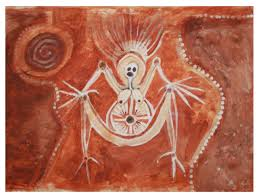
Most people hang art because it looks nice. They find a piece that speaks to them, slap it on the wall, and call it a day. But something much more intriguing happens beneath the surface that most homeowners never consider, the ability of certain artwork to genuinely change how one moves and experiences a room. Aboriginal art boasts fascinating patterns of dots, lines, and more that impact room dynamics in a way that’s greater than aesthetic appeal.
Such patterns are not arbitrary decorations. They are visual languages honed over thousands of years, and when they’re brought into the household, they activate relationships with your line of sight and cognition that impact everything from where you stand to how long you’re willing to stay in a room.
The Science of Pattern Recognition and Spatial Action
So, what exactly happens when you enter a room with Aboriginal art all around? Your brain starts firing off little connections before you even consciously assess what you’re seeing. Those concentric circles; the lines radiating or in clusters; they all create visual pathways your eyes want to follow.
Where your eyes go, your body tends to follow. It’s not dramatic or overt, but studies in visual cognition suggest that movement patterns manifest by virtue of directional visuals placed in our environments. Aboriginal art often employs linear quality with strength that either radiates from or toward something or flows as directed. These lines serve as invisible pathways in your space that make rooms feel purposeful and active.
Dot Patterns and an Aesthetic Slowing Down
On the other hand, if you have Aboriginal dot paintings from which to draw, something exciting happens to your pace when you enter a room. Densely clustered dots create “visual weight”, areas of attraction that ground people in the best way possible. When you have these sections on your walls, people find themselves naturally slowing down around them. They pause. They look closer. They enjoy the space more.
It’s not arbitrary, either. The technique behind traditional dot paintings draws eyes in through depth of field created by distance. From across the room, you see one thing. The closer you get, the more details emerge into distinguishable patterns.
Up close, you realize that things are even made up of different colors from what looked like one solid hue from across the way. This gradual revelation makes people want to come in and investigate, and inevitably alters how they use that part of the room, making it far more engaging.
Directional Lines and Natural Pathways
Furthermore, Aboriginal art often employs lines with direction, paths marking footsteps made by ancestors, lines in the sand showing how water flows or circles and radiating patterns that demonstrate vital gathering locations. For those assessing authentic works that demonstrate these traditional elements, sites like aboriginal-art-australia.com boast collections of directional storytelling from various regions boasting recognizably different styles.
When these patterns are featured on your walls, they create “implied motion,” a phenomenon studied by spatial psychologists who find that these eye-mapping elements positively confer a sense of room flow once integrated into one’s periphery.
For example, if something on the wall has strong horizontal directionality, a long but narrow space may feel wider upon investigation than its physical characteristics allow. Vertical lines pull energy upward and make ceilings feel higher and spaces more expansive. Radiating patterns from a center provide kinetic energy that expands spaces more than their physical realities suggest.
The best part? This works whether or not you’re actively focusing on it. Once your brain assimilates what it’s seeing and maps the visual directions within a space, that subconscious appeal renders an optimistic position for everyone naturally moving about as they feel comfortable based on what little guidance the movement provides.
Color Blocks and Psychological Borders
Aboriginal art boasts serious color blocks, ocher here, white there, black over there, and increasingly, modern-day palettes add contrast as well. These color segments do more than create sections on canvas; they play on architectural integrates to create pockets of psychological impact that feel encouraging and well-defined.
Take for example a large Aboriginal piece, a canvas dominated by red ocher as pigment can do two things: make the wall feel warmer and more intimate or give the wall a coolness about it that suggests otherwise. With an intimate feeling comes warmth for a conversational area; with a coolness extends a more expansive feeling. When one speaks of shaping a space via art, this is, in part, what is meant, the artwork physically alters how the mind perceives boundaries in the most positive sense.
This is particularly true for an open floor plan where real walls do not dictate separate atmospheres. A prominent piece can help dictate a transition from one segment of a house to another without feeling cut off. The living room ends here; the dining area begins there, not because there are walls separating them but because this art facilitates perceptual shifts helping make the layout more cohesive.
The Centering Effect of Centrist Compositions
Much Aboriginal art features central compositions (important locations, watering holes, ground providing places for ceremonial practices) with radiating components all relating back toward that center. When hung in a particular location, something curious happens; visually it creates a “visual anchor,” and it can be fascinating to see how this plays out.
People want to orient themselves toward these centers. Furniture arrangements make more sense when adjusted toward the center or while centered themselves and in social areas, these areas truly become warm spots where conversation florists because it’s so easy for people to sit there as opposed to somewhere else aiming elsewhere. The piece acts as an inadvertent gathering point, not because people are constantly looking at it; instead, it’s actively creating an overarching center that makes particular parts of the room more welcoming, and social.
Layered Patterns and Extended Appeal
Many traditional styles boast layered nuances, patterns within patterns, meanings within meanings, and are visually distinct as such. This has fascinating potential appeal on how long people want to stay in a given space and how comfortable people are while doing so: it’s all positive.
When rooms boast visually simple art or worse, no art at all, things can get bland after some time. No eye has anywhere to go; there’s nothing new to discover, and considering boredom happens rapidly with minimal engagement through peripheral observation doesn’t bode well for comfortably enjoying rooms for long periods of time.
On the other hand, when spaces boast Aboriginal visual complexity through layered works, one’s brain has something satisfying to engage with passively since there may be no constant staring at what’s before them anyway, this could be too obvious. Instead, the nuances provide revelations just to the left or right as people go about their business naturally maintaining interest through peripheral proximity, and this reduces visual fatigue. Thus, rooms feel much more comfortable and interesting for prolonged periods of time.
The Rhythm of Repeated Motifs
Another interesting element is how many styles boast repeated elements, the same symbol appearing; dot patterns repeating with slight variation; circular motifs repeated throughout the composition, we call this visual rhythm. And it’s fascinating how rhythm impacts time perception positively.
For example, rooms with rhythms can feel dynamic or calming based on which “tempo” you’ve picked up on. From fast-paced motions to softer ones, smaller spaces can feel energized, or artistic studio spaces can feel calmer than expected. Alternatively, waltz through your bedroom at sunset and its soft edges will make it feel like anything but an overwhelmed space.
Creating Patterns
The bottom line? This information is incredibly practical. When you’re trying to find Aboriginal art for your house it’s all fine and good to simply assess if you like it while it’s there but think about where the tonal weight sits in the pattern you’ve chosen and how it might generate applicable tones. The slightest direction in which motions lead can create intimacy or expansion; does it draw you in or push you away? Your room’s purpose will rely upon your intention yet patterns will facilitate outcomes you’d never expect.
Aboriginal art brings something truly magical to interior spaces, visually complex elements that speak culturally for meaning instead of arbitrary decoration. While these kinds of patterns line our walls creating empathy visually mapped by direction wasn’t meant for traditional homes, yet it works out rather well creating spaces that operate naturally while taking on an agency all their own even overtime making them that much more appreciated, even inadvertently every single day you live there.
