

Key Takeaways
- Start with a site-specific review of people, spaces, routines, and likely weak points.
- Connect staffing, access control, communication, and emergency procedures into one workable system.
- Use simple written duties so every team member knows what to observe, report, and escalate.
- Plan for everyday disruptions as well as fire, medical events, severe weather, and crowd-related concerns.
- Test parts of the plan regularly, document gaps, and assign deadlines for fixes.
Security planning works best when it starts with the people who use a property every day. Whether the setting is a Back Bay office, a Seaport residential building, a neighborhood retailer, or an event space near a major transit route, leaders need clear procedures that protect people without disrupting normal operations. A thoughtful approach to security staffing in Boston, MA, can help turn those procedures into consistent day-to-day coverage. A visible presence at an entrance is only one part of a strong plan. The larger goal is to help employees, tenants, guests, contractors, and managers understand what to do before, during, and after a problem. When roles, access rules, and communication methods are documented in advance, teams can respond with less confusion during stressful moments.
Why a Written Plan Matters
Informal habits can work on an ordinary day, but they may fail when a fire alarm sounds, a delivery entrance is left open, or a manager is unavailable. Written procedures make decision-making easier by identifying responsibilities, reporting steps, emergency contacts, and safe routes before an incident occurs. A mixed-use Boston property may have office workers arriving in the morning, vendors at a loading area, retail customers throughout the day, and private events in the evening. A single plan should account for those changing conditions. Boston organizations can also draw on the City’s business continuity resources to maintain essential operations and recover from a disruption.
Start With a Simple Risk Review
A risk review does not require predicting every possible threat. It requires an honest look at the property, the people who use it, and the points where daily activity can create a security or safety gap.
Questions to Ask
- Which doors, stairwells, service corridors, parking areas, and loading zones need closer attention?
- When are arrivals, departures, deliveries, and shift changes busiest?
- Where are sensitive records, cash, equipment, hazardous materials, or restricted systems located?
- What happens if electricity, elevators, phones, internet service, or badge readers stop working?
- Who may need additional assistance during an evacuation or shelter situation?
Walk the site during normal and peak hours, review prior incidents and near misses, then rank concerns by likelihood and potential harm. Each high-priority issue should have an owner, a practical corrective action, and a completion date.
Match Staffing to the Site
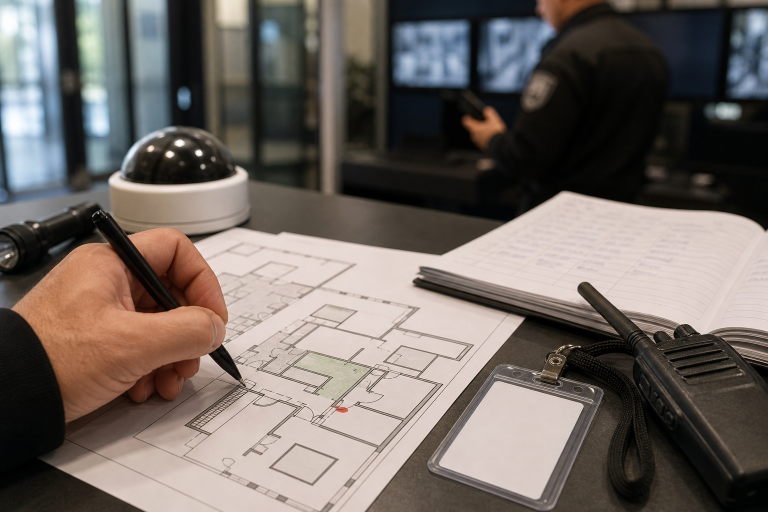
Staffing should reflect the layout and activity of the location. A small professional office, an apartment community, a laboratory, and a venue hosting public events have different needs. Consider fixed posts in lobbies and sensitive areas, mobile patrols in exterior zones, and additional coverage during openings, closings, deliveries, or special events. Every assigned role should be written in plain language. Team members need to know what they are expected to watch, what they should document, who should receive an escalation, and when they should step away from a situation and request emergency help. Supervisors also need backup coverage for breaks, absences, and sudden increases in activity.
Build Clear Access Control Rules
Access control is an operating process, not simply a badge reader or locked door. Establish separate expectations for employees, visitors, vendors, contractors, and temporary workers. Credentials should match job duties and be removed promptly when access is no longer needed.
- Use visitor logs and escort procedures that reception teams can follow consistently.
- Address lost badges, shared credentials, propped doors, and tailgating directly.
- Keep emergency exits usable and avoid creating barriers to evacuation.
- Maintain current emergency contacts and authorized access lists.
Boston properties may also consider whether the Corporate Emergency Access System is relevant to their facility and emergency planning. Internal access records still matter because building managers must be able to quickly identify key holders, tenant contacts, utility information, and restricted areas.
Prepare for Common Emergencies
Emergency procedures should cover fire and smoke, medical events, power loss, water damage, severe winter weather, extreme heat, suspicious behavior, forced-door alarms, and unexpected crowd activity. For each scenario, use the same five-step framework:
- Recognize and verify the problem.
- Protect people from immediate danger.
- Notify the appropriate internal contacts and emergency services.
- Preserve safe access, exit, and responder routes.
- Record the event and review the response afterward.
Create a Reliable Communication Chain
Communication often becomes difficult when managers, tenants, maintenance teams, security personnel, remote leadership, and first responders all need different information. Maintain a current contact list with primary and backup contacts, and use multiple methods for urgent messages in case phone or internet service is unavailable. Messages should be short and specific. State what happened, what people should do, where they should go, and when the next update is expected. Designate one person or team to approve external messages, while another person maintains a log of important calls, decisions, and handoffs.
Plan for Busy Days and Events
Boston’s calendar can quickly change traffic, pedestrian flow, deliveries, and emergency access. Conferences, concerts, sports activities, holiday shopping, demonstrations, severe weather, and neighborhood events can all require temporary adjustments. Massachusetts’ coordinated preparations for the 2026 FIFA World Cup included planning for transportation, crowd management, public health, cybersecurity, and emergency response, which offers a useful reminder that large events require coordinated roles and early communication.
- Estimate attendance and peak arrival periods.
- Map entrances, exits, queues, deliveries, and emergency lanes.
- Confirm contact information for property, transportation, medical, fire, and police partners.
- Brief every team before the activity begins and hold a short review afterward.
Train, Test, and Improve the Plan
A plan is useful only when people can apply it without having to search through a long manual. Provide short, repeated training on de-escalation, emergency notification, evacuation, visitor procedures, incident reporting, and accessibility needs. Employees need basic reporting guidance, while supervisors, reception teams, maintenance workers, and designated responders may need role-specific instruction. Test one part of the plan at a time. Run a tabletop discussion, check a communication tree, walk an evacuation route, or simulate an access-control failure. Record delays, unclear duties, and missing supplies, then assign corrective actions and revisit them until they are complete.
Final Checklist
- Complete a current site risk review.
- Assign roles, escalation paths, and backup contacts.
- Review doors, keys, credentials, visitors, vendors, and emergency access.
- Create clear procedures for likely emergencies.
- Prepare for crowded days and temporary operating changes.
- Train teams in practical, site-specific actions.
- Test one part of the plan each quarter.
- Track gaps until they are resolved.
A practical security plan does not need to be complicated. For Boston, Massachusetts organizations, it should match the property, reflect real daily routines, and give people clear actions. Consistent staffing, sensible access controls, reliable communication, and regular practice can help create a calmer and safer response when conditions change.
