
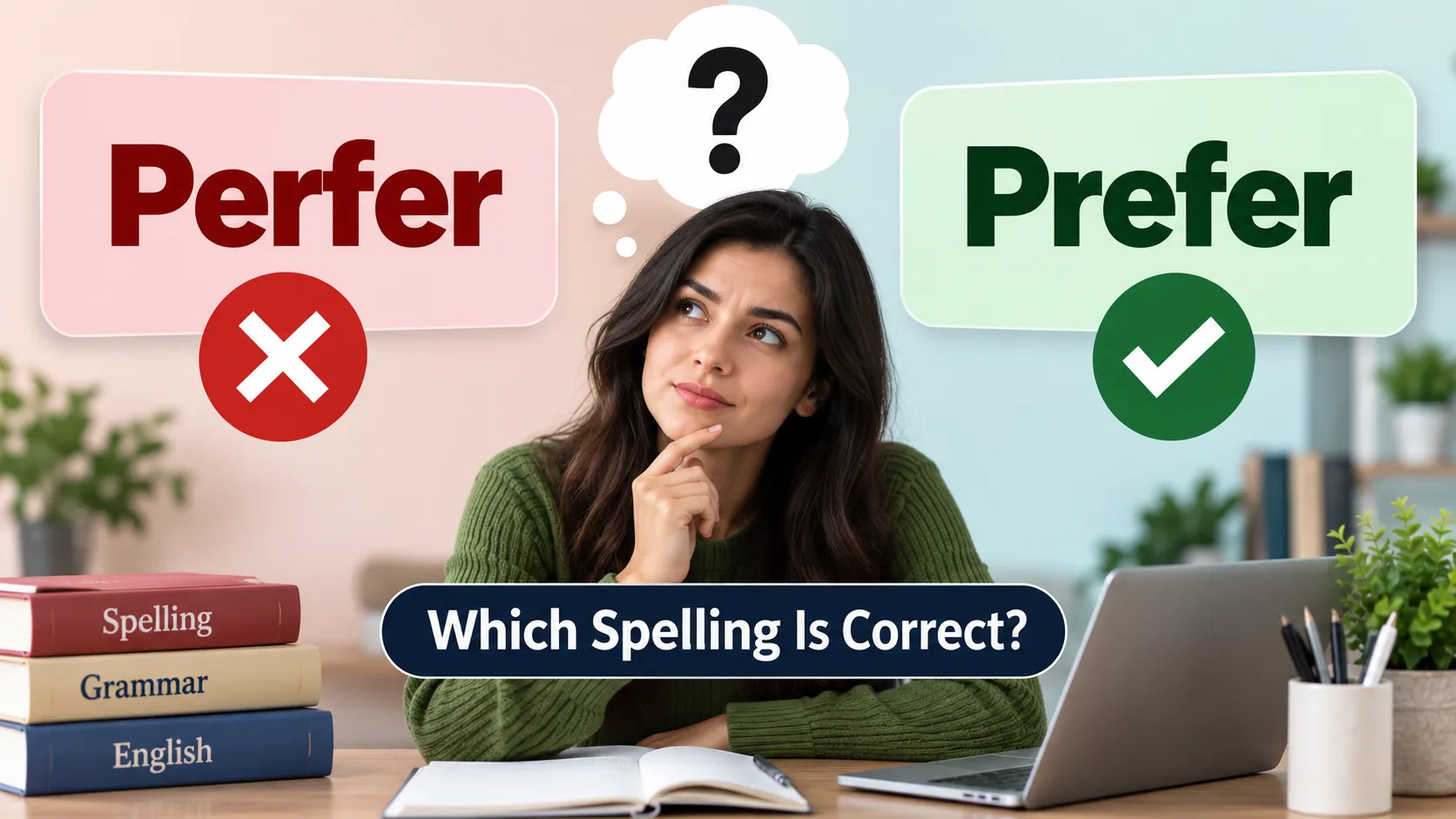
“Perfer” and “prefer” look almost identical, so it is easy to type the wrong one. However, only one of these spellings is correct in standard English.
Prefer is the correct spelling, while perfer is a misspelling. The word “prefer” is a verb used when someone likes, chooses, or wants one thing more than another.
Understanding the correct spelling is only the first step. You also need to know how “prefer” works in sentences, especially when comparing two things or talking about choices.
Perfer Vs Prefer: Quick Difference
Prefer Is The Correct Spelling
Prefer is the standard English spelling.
For example:
- I prefer tea to coffee.
- She prefers summer to winter.
- Which restaurant do you prefer?
- I prefer to stay home tonight.
The spelling is P-R-E-F-E-R.
Perfer Is Incorrect
Perfer is a common spelling mistake, but it is not the standard spelling of the verb.
For example:
- Incorrect: I perfer coffee.
- Correct: I prefer coffee.
If you are writing an email, article, school assignment, or professional message, always use prefer.
The Simple Rule
Remember:
PRE + FER = PREFER
The word begins with pre, not per.
A useful memory trick is to connect “prefer” with related words such as preference, preferable, and preferably. They all begin with pref-.
What Does “Prefer” Mean?
Prefer Means Like Something More
“Prefer” means to like or want one thing more than another.
For example:
I prefer coffee to tea.
This means you like coffee more than tea.
Another example is:
She prefers cats to dogs.
The sentence tells us which option she favors.
Prefer Can Describe Choices
You can use “prefer” when making everyday choices.
Examples include:
- I prefer the blue shirt.
- He prefers working in the morning.
- We prefer quiet restaurants.
- They prefer online classes.
- She prefers winter weather.
The word does not always require a direct comparison. You can simply state what someone generally likes or chooses.
Prefer Can Have Other Meanings
“Prefer” also has some less common meanings in formal or specialized English.
For example, legal English can use “prefer charges” to mean officially bringing an accusation against someone. Older uses can also involve advancing or promoting someone.
For everyday writing, however, the meaning of choosing or liking one thing more is by far the most common.
Why Do People Write “Perfer”?
The Spelling Looks Natural
“Perfer” may look reasonable because English contains many words beginning with “per.” When people write quickly, they can easily put per instead of pre.
The pronunciation can also make the spelling less obvious, especially for people learning English.
Prefer Starts With “Pre”
The correct spelling begins with:
P-R-E
Then comes:
F-E-R
Together:
P-R-E-F-E-R
Thinking of the first three letters as pre can help prevent the common “perfer” mistake.
Related Words Use “Pref-”
Another useful clue is the spelling of related words:
- prefer
- preference
- preferable
- preferably
Seeing the shared pref- beginning makes the correct spelling easier to remember.
How To Use “Prefer” In A Sentence
Prefer One Thing To Another
The most common comparison pattern is:
prefer A to B
Examples:
- I prefer tea to coffee.
- She prefers summer to winter.
- He prefers books to movies.
- We prefer quality to quantity.
For example:
I prefer walking to driving.
This means walking is the option you like more.
Prefer To + Verb
You can use “prefer” before a to-infinitive when talking about an action.
Examples:
- I prefer to walk.
- She prefers to stay home.
- We prefer to eat early.
- They prefer to travel by train.
The structure is:
prefer + to + verb
So:
I prefer to walk.
is correct.
Prefer + -Ing
“Prefer” can also be followed by an -ing form, especially when discussing activities.
Examples:
- I prefer reading to watching television.
- She prefers swimming to running.
- They prefer working in the morning.
- He prefers cooking at home.
When comparing two activities, a common structure is:
prefer + -ing + to + -ing
For example:
I prefer reading to watching movies.
Prefer To Or Prefer Than?

Prefer To Is The Standard Form
When directly comparing two things, use to rather than than.
Correct:
I prefer tea to coffee.
Incorrect:
I prefer tea than coffee.
This is one of the most common grammar mistakes involving “prefer.”
Why “Than” Causes Confusion
People sometimes use “than” because it commonly appears with comparative words such as “better,” “faster,” and “rather.”
For example:
I would rather drink tea than coffee.
But with “prefer,” the standard comparison is:
I prefer tea to coffee.
Keeping these two patterns separate makes the grammar easier to remember.
Prefer To vs Would Rather
These structures express similar ideas but use different grammar.
With prefer:
I prefer tea to coffee.
With would rather:
I would rather drink tea than coffee.
Both are correct, but their sentence structures are different.
Is “Prefer Over” Correct?
Prefer Over Is Used In English
You may also see prefer over in modern English.
For example:
Many customers prefer online shopping over visiting physical stores.
This construction appears in standard usage, particularly when discussing alternatives or choices.
Prefer To Is Usually Simpler
For a straightforward comparison, prefer A to B is the clearest structure.
For example:
I prefer tea to coffee.
This is simple, natural, and widely accepted.
“Prefer over” is not the same spelling or grammar issue as “perfer.” The important point is that prefer remains the correct spelling in both constructions.
Choose The Structure That Fits
Use:
- prefer A to B for direct comparisons
- prefer to + verb for actions
- prefer -ing to -ing for activities
- would rather + verb + than for an alternative structure
This gives you several correct ways to express preferences.
Prefer Vs Would Prefer
Use “Prefer” For General Preferences
“Prefer” is useful for regular or general choices.
For example:
I prefer tea to coffee.
This suggests a general preference.
Another example:
She prefers working from home.
This can describe her usual preference.
Use “Would Prefer” For Specific Choices
“Would prefer” often refers to a particular situation or choice.
For example:
I would prefer to leave early today.
Or:
Would you prefer coffee or tea?
It is especially common when making requests or asking someone what they want.
“Would Prefer” Can Be Polite
You can use “would prefer” when expressing a choice politely.
For example:
I would prefer not to discuss it right now.
This sounds less direct than simply saying:
I don’t want to discuss it.
Prefer, Preferred, And Preferring
Prefer
The base form is:
prefer
Example:
I prefer tea.
Prefers
For third-person singular subjects, add -s:
prefer → prefers
Example:
She prefers tea.
Preferred
The past form and past participle are:
prefer → preferred
Example:
We preferred the earlier version.
Notice that the final r is doubled before -ed.
Preferring
The -ing form is:
prefer → preferring
Example:
They are preferring the newer option.
The spelling changes because of standard English spelling rules.
Common Spelling Mistakes With “Prefer”
Perfer
Incorrect:
I perfer chocolate.
Correct:
I prefer chocolate.
The incorrect form switches the positions of r and e in the first part of the word.
Prefered
Incorrect:
She prefered the blue one.
Correct:
She preferred the blue one.
The correct past form has two r letters:
preferred
Prefering
Incorrect:
He is prefering coffee.
Correct:
He is preferring coffee.
The correct form doubles the final r before adding -ing.
Prefer Than
Incorrect:
I prefer tea than coffee.
Correct:
I prefer tea to coffee.
The problem here is not spelling but sentence structure.
If you are interested in another commonly confused English spelling, see our guide to speach or speech for a similar example of choosing the correct form.
Prefer Vs Preference
Prefer Is A Verb
The word “Prefer” describes the act of liking or choosing something more.
For example:
I prefer coffee.
Here, “prefer” is the verb.
Preference Is A Noun
“Preference” is the related noun.
For example:
Coffee is my preference.
You can also say:
My preference is coffee.
Knowing the difference helps you avoid using the wrong word in a sentence.
Preferable Is An Adjective
“Preferable” describes something that is more desirable or suitable.
For example:
The earlier option is preferable.
So the related forms are:
- prefer = verb
- preference = noun
- preferable = adjective
- preferably = adverb
Prefer In Everyday Examples
Food And Drinks
I prefer tea to coffee.
She prefers water to soda.
Would you prefer juice or milk?
These are common ways to use “prefer” when discussing food and drinks.
Activities
I prefer reading to watching television.
He prefers walking to driving.
They prefer to exercise in the morning.
The word works naturally with both activities and general choices.
Work And Travel
I prefer working from home.
She prefers to travel by train.
We prefer the morning flight.
These examples show how “prefer” can describe personal choices in everyday situations.
When writing about other common English expressions, it can also help to understand related distinctions such as you to or you too, where two similar-looking forms have different grammatical roles.
Perfer Vs Prefer Examples
Quick Comparison Table
| Word Or Phrase | Correct? | Meaning Or Use | Example |
| Prefer | Yes | Like or choose more | I prefer tea. |
| Perfer | No | Misspelling of prefer | I perfer tea. |
| Preferred | Yes | Past form | I preferred tea. |
| Prefered | No | Misspelling of preferred | I prefered tea. |
| Preferring | Yes | -ing form | She is preferring one option. |
| Prefering | No | Misspelling of preferring | Incorrect spelling |
| Preference | Yes | Noun | Tea is my preference. |
| Preferable | Yes | More desirable | This option is preferable. |
The main spelling distinction is straightforward: prefer is correct, and perfer is not.
Prefer Vs Choose
Prefer Describes A Favoring
The word “Prefer” tells us that one option is liked or wanted more than another.
I prefer coffee to tea.
Choose Describes A Decision
“Choose” focuses more directly on the act of making a decision.
I chose coffee instead of tea.
You can have a preference without making a final choice. For example, you may prefer coffee but still choose tea on a particular day.
Both Can Appear Together
For example:
I prefer coffee, so I chose it this morning.
This sentence shows the difference clearly. “Prefer” describes the general liking, while “chose” describes the specific decision.
How To Remember “Perfer” Or “Prefer”
Think “Pre”
Break the word into two simple parts:
PRE + FER
This gives you:
PREFER
The first three letters are pre, not per.
Connect It With “Preference”
If you know how to spell preference, you already know the important first part of “prefer.”
Both begin with:
PREF
So:
prefer
preference
preferable
Use The “Also” Trick For Related Grammar
When working with other commonly confused words, checking the meaning can help before checking the spelling. For example, you too means “you also,” while “you to” has a different grammatical function.
This kind of meaning-based check can make common English word choices much easier.
FAQs
Is “Perfer” A Correct Word?
No. “Perfer” is generally considered a misspelling of the correct word prefer.
Is It “Perfer” Or “Prefer”?
The correct spelling is prefer.
What Does “Prefer” Mean?
“Prefer” means to like, choose, or want one thing more than another.
Do You Say “Prefer To” Or “Prefer Than”?
For a direct comparison, the standard construction is prefer A to B, such as “I prefer tea to coffee.”
Can You Say “Prefer Over”?
Yes. “Prefer over” is used in English, although prefer A to B is a clear and traditional structure for direct comparisons.
Is “Preferred” Spelled With Two Rs?
Yes. The correct past form is preferred, with two Rs.
Is It “Prefering” Or “Preferring”?
The correct spelling is preferring, with two Rs.
Is “Prefer” A Verb?
Yes. “Prefer” is a verb.
What Is The Noun Form Of “Prefer”?
The common noun form is preference.
How Do You Remember The Spelling Of Prefer?
Remember PRE + FER = PREFER. You can also connect it with related words such as “preference” and “preferable.”
Final Takeaways
The correct spelling is prefer, not perfer. “Prefer” is a verb used to express a choice or a stronger liking for one thing over another, and it commonly appears in structures such as “prefer A to B” and “prefer to + verb.” Related forms include “preferred,” “preferring,” “preference,” and “preferable.” The easiest way to remember the spelling is to think PRE + FER = PREFER.
