
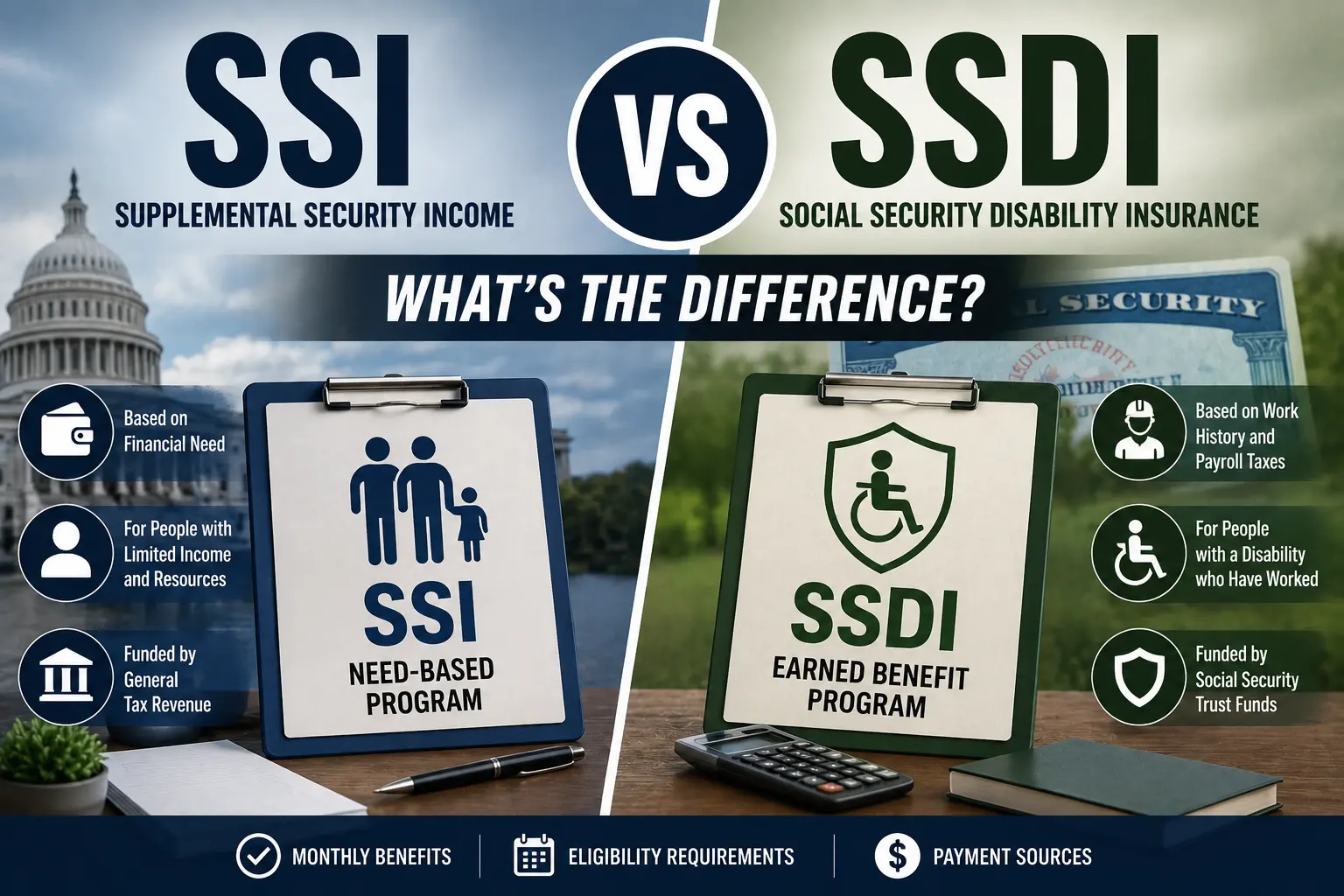
SSI vs SSDI is a common question for people trying to understand Social Security disability benefits. Although both programs provide financial assistance, they have different eligibility requirements and are designed for different situations.
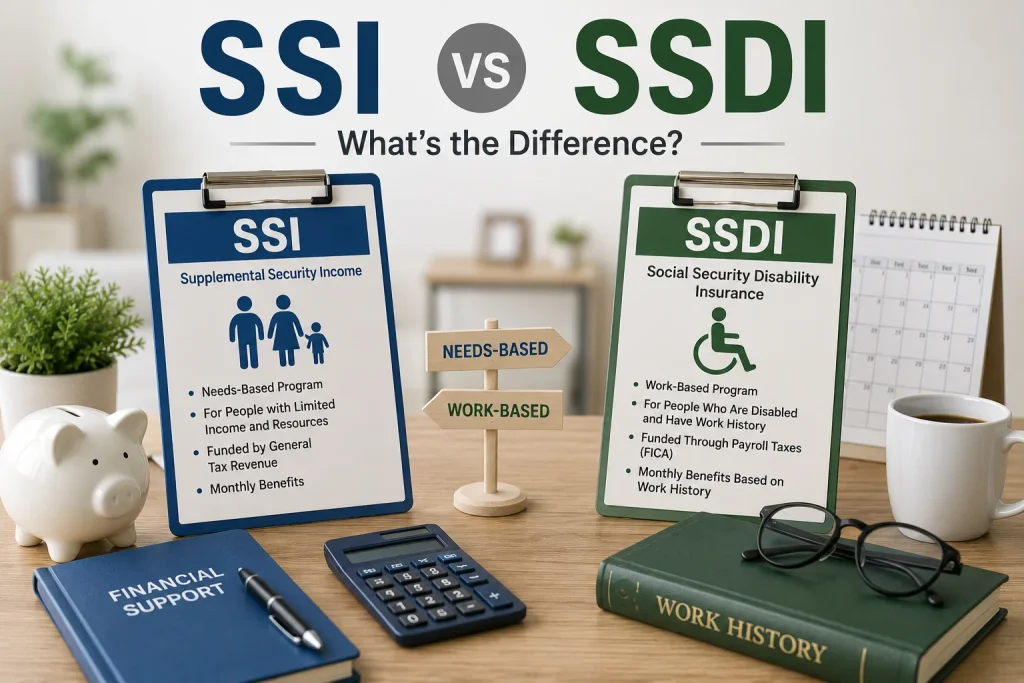
SSI, or Supplemental Security Income, is mainly based on financial need and limited income and resources. SSDI, or Social Security Disability Insurance, is generally based on disability and a person’s qualifying work history.
The two programs can sometimes overlap, and a person may qualify for both at the same time. Understanding their differences in work credits, income limits, benefits, healthcare coverage, and eligibility can make the comparison much easier.
What Is SSI?
SSI stands for Supplemental Security Income. It is a federal program that provides monthly payments to people who are aged, blind, or disabled and have limited income and resources.
SSI is funded through general federal tax revenues rather than Social Security payroll taxes. Unlike SSDI, SSI does not require a person to have enough work credits.
Adults under 65 generally need to meet the Social Security Administration’s disability or blindness requirements. People aged 65 or older can qualify based on age without establishing a disability.
How Does SSI Eligibility Work?
SSI eligibility depends heavily on financial circumstances. The SSA considers income, resources, living arrangements, and other factors when deciding whether someone qualifies.
For 2026, the general resource limit is $2,000 for an individual and $3,000 for a couple. Some assets, such as a person’s primary home and certain vehicles, may not count toward these limits.
Income can also affect eligibility and payment amounts. Certain income exclusions apply, so total income is not always the same as countable income.
How Much Does SSI Pay?
For 2026, the maximum federal SSI payment is $994 per month for an eligible individual. The maximum is $1,491 per month for an eligible couple.
These are maximum federal amounts rather than guaranteed payments. Countable income and living arrangements can reduce the actual payment.
Some states may also provide additional SSI-related payments. State supplements and eligibility rules can vary.
What Is SSDI?
What Does SSDI Stand For?
SSDI stands for Social Security Disability Insurance. It provides benefits to people who have a qualifying disability or blindness and have sufficient Social Security work history.
SSDI is funded through Social Security payroll taxes. The program works more like insurance because eligibility depends on having earned enough qualifying work credits.
The required work history depends partly on the person’s age when their disability begins. Younger workers can generally qualify with fewer credits.
How Does SSDI Eligibility Work?
SSDI generally requires both a qualifying disability and sufficient insured status. The applicant must meet the SSA’s disability definition and have enough qualifying work history.
For adults, the disability generally must prevent substantial gainful activity and be expected to last at least 12 months or result in death.
Work credits are earned through covered earnings. In 2026, one Social Security work credit requires $1,890 in covered earnings, with a maximum of four credits available per year.
How Much Does SSDI Pay?
SSDI does not have one fixed federal payment amount. The benefit is generally based on the worker’s earnings history covered by Social Security.
Someone with higher qualifying earnings may receive a larger SSDI benefit than someone with a lower earnings history. The amount can therefore vary substantially between recipients.
Having more work credits than required does not simply produce a larger benefit. Credits mainly help establish eligibility, while the earnings record affects the benefit calculation.
SSI Vs SSDI: Main Differences
Income And Resources
SSI has strict financial requirements. The SSA considers income and countable resources when determining eligibility and calculating payments.
SSDI does not have the same $2,000 individual or $3,000 couple resource limits. A person’s savings and other assets generally do not determine basic SSDI eligibility.
However, work earnings can matter for SSDI. Substantial gainful activity rules can affect whether someone meets the disability requirements.
Work History
SSI does not require a qualifying work history. Someone who has never worked can potentially qualify if they meet the other requirements.
SSDI generally requires sufficient work credits. The required number varies according to the person’s age and work history.
This is one of the easiest ways to remember the difference. SSI focuses on financial need, while SSDI relies heavily on Social Security insurance coverage.
Benefit Amount
SSI has a maximum federal payment that is adjusted periodically. The 2026 federal maximum is $994 per month for an individual.
SSDI benefits depend largely on the person’s covered earnings record. There is therefore no single SSDI payment that applies to everyone.
Someone with a strong earnings history may receive more through SSDI. A person with little or no work history may instead qualify for SSI.
SSI Vs SSDI: Medicare And Medicaid
SSI is generally associated with Medicaid. Medicaid provides health coverage for eligible low-income individuals, although specific procedures can differ by state.
In many states, SSI recipients are automatically eligible for Medicaid. Other states require a separate Medicaid application.
Because Medicaid is jointly administered by federal and state governments, the exact process can vary depending on where the recipient lives.
SSDI And Medicare
SSDI recipients generally become eligible for Medicare after the applicable waiting period. The SSA states that Medicare entitlement generally begins after 24 months of SSDI benefits.
This makes healthcare coverage another important difference between the programs. SSI is generally connected with Medicaid, while SSDI is generally connected with Medicare after the waiting period.
There are special rules and exceptions for certain conditions. Medicare eligibility should therefore be checked with the SSA for an individual case.
Can Someone Receive Both?
Yes, some people can receive SSI and SSDI simultaneously. This is commonly called concurrent eligibility.
For example, someone may have enough work history for SSDI but have a relatively low SSDI payment and limited financial resources. They may qualify for SSI as well.
However, SSDI payments generally count as income for SSI purposes. This can reduce the person’s SSI payment.
SSI Vs SSDI: Working While Receiving Benefits
Working With SSI
SSI does not automatically stop when someone begins working. Instead, countable earnings generally reduce the SSI payment under the program’s income rules.
The SSA generally excludes some income before calculating the reduction. For earned income, SSI payments typically decrease by about $1 for every $2 of countable earnings.
Special work incentives can also apply. These rules allow some recipients to work while maintaining access to benefits and related support.
Working With SSDI
SSDI also has work incentives. One important provision is the Trial Work Period, which allows beneficiaries to test their ability to work without immediately losing SSDI benefits.
For 2026, a month generally counts toward the Trial Work Period when earnings reach $1,210. Other rules apply after the Trial Work Period.
The SSA also uses substantial gainful activity when evaluating disability. For 2026, the SGA amount is $1,690 per month for non-blind individuals and $2,830 for people who meet the SSA’s blindness definition.
Why Work Rules Matter
Working while receiving disability benefits can involve detailed rules. Reporting earnings correctly is important because the consequences can differ between SSI and SSDI.
People should not assume that starting a job immediately ends their benefits. Each program has work incentives and specific reporting requirements.
The SSA can provide current guidance based on the person’s benefit type and circumstances.
SSI Vs SSDI For Different People
People Who Have Never Worked
SSI may be the relevant program for someone who has never worked. Because SSI does not require work credits, a person can potentially qualify based on disability, blindness, age, income, and resources.
SSDI generally requires qualifying work history. Someone without sufficient credits may not qualify for SSDI on their own work record.
Family benefits can create different possibilities in certain situations. Social Security rules can allow some people to receive benefits through another person’s work record.
Married Couples
Marriage can affect SSI because the program considers certain income and resources of a spouse. This process is sometimes called deeming.
SSDI generally does not use the same household resource test. A spouse’s income normally does not determine the worker’s basic SSDI eligibility.
However, eligible family members can potentially receive Social Security benefits based on a disabled worker’s record. The rules depend on the family relationship and other requirements.
Children
Children can qualify for SSI when they meet the program’s disability and financial requirements. Parental income and resources may be considered when a disabled child lives with their parents.
Children may also qualify for certain Social Security benefits based on a parent’s work record. These benefits are separate from the basic SSI eligibility process.
The rules for children can be more complicated than those for adults. Parents should check the SSA’s current requirements before applying.
SSI Vs SSDI: Which One Is Better?
When SSI May Be More Relevant
SSI may be more relevant for someone with little income, limited resources, and insufficient work history for SSDI. It can provide support even when a person has never worked.
The program can also cover qualifying people aged 65 or older without requiring disability. Disabled or blind children may also qualify.
The main limitation is its strict financial test. Income and resources can affect both eligibility and the amount received.
When SSDI May Be More Relevant
SSDI may be more relevant for someone who has a qualifying disability and sufficient Social Security work history. The payment is connected to the person’s earnings record rather than household resources.
SSDI can also provide access to Medicare after the applicable waiting period. Certain family members may potentially receive benefits through the worker’s record.
However, someone without enough work credits may not qualify for SSDI. In that situation, SSI may be an alternative if the person meets its financial requirements.
When Both May Apply
Some applicants qualify for both programs. This can happen when someone has enough work history for SSDI but receives a relatively low SSDI benefit and has limited income and resources.
Receiving both does not mean receiving the maximum amount from each program. SSDI generally counts as income when SSI eligibility and payment are calculated.
The result depends on the individual’s circumstances. The SSA determines eligibility separately under each program’s rules.
SSI Vs SSDI Compared With Other Terms
Why Similar Terms Cause Confusion
SSI and SSDI sound similar because both involve Social Security and disability. Their actual eligibility systems are different, much like other terms that describe related but separate roles or concepts.
For example, understanding the difference between a sheriff and police requires looking at their authority, jurisdiction, and responsibilities. The same approach helps when comparing SSI and SSDI.
Instead of focusing only on their names, compare what each program is designed to do. This makes the eligibility rules easier to understand.
Programs And Professional Titles
Acronyms can also represent very different things in other fields. A comparison such as DDS vs DMD shows why two professional titles can appear different while referring to closely related qualifications.
SSI and SSDI have a similar naming problem. Both involve disability benefits, but their financial and work-history requirements are not interchangeable.
Understanding the purpose behind each acronym is often more useful than memorizing the names alone.
Eligibility Depends On Specific Requirements
Disability programs also require attention to individual circumstances. Factors such as income, work history, age, resources, and medical eligibility can affect the result.
This is similar to how physical characteristics can influence breathing patterns, such as the differences between a mouth breather and nose breather. Related concepts can still have distinct definitions and practical effects.
For SSI and SSDI, checking the exact SSA requirements is more reliable than assuming one program automatically applies.
FAQs
What Is The Main Difference Between SSI And SSDI?
SSI is primarily based on financial need, while SSDI is based largely on disability and qualifying Social Security work history. Both are administered by the Social Security Administration.
Which Pays More, SSI Or SSDI?
There is no universal answer. SSI has a maximum federal payment, while SSDI payments vary according to the recipient’s earnings history.
Can You Get SSI And SSDI At The Same Time?
Yes. Some people qualify for both programs, although SSDI income can reduce the amount of SSI they receive.
Does SSI Require Work Credits?
No. SSI does not require the work credits needed for SSDI.
Does SSDI Have An Asset Limit?
SSDI does not have the same SSI-style resource limits. Savings and other assets generally do not determine basic SSDI eligibility.
What Is The SSI Resource Limit In 2026?
The general limit is $2,000 for an individual and $3,000 for a couple. Certain assets are excluded under SSI rules.
How Much Is SSI In 2026?
The maximum federal SSI payment is $994 per month for an individual and $1,491 for an eligible couple. Actual payments can be lower.
When Does SSDI Get Medicare?
Medicare generally begins after 24 months of SSDI benefits, subject to applicable rules and exceptions.
Can You Work While Receiving SSI Or SSDI?
Yes. Both programs have work incentives, but earnings can affect benefits and eligibility under different rules.
Which Is Better, SSI Or SSDI?
Neither is automatically better. SSI may suit someone with limited income and resources, while SSDI may provide more support to someone with sufficient work history and a stronger earnings record.
Final Takeaways
SSDI does not use the same SSI resource limits, and its payment amount generally depends on the worker’s covered earnings record. SSI recipients are generally associated with Medicaid, while SSDI recipients generally become eligible for Medicare after the applicable waiting period. Some people can qualify for both programs, although SSDI payments can reduce SSI benefits.
The best way to determine which program may apply is to look at work history, income, resources, age, and disability requirements together. Because Social Security rules and annual payment thresholds can change, current information from the Social Security Administration should be used when making an application or benefits decision.
