
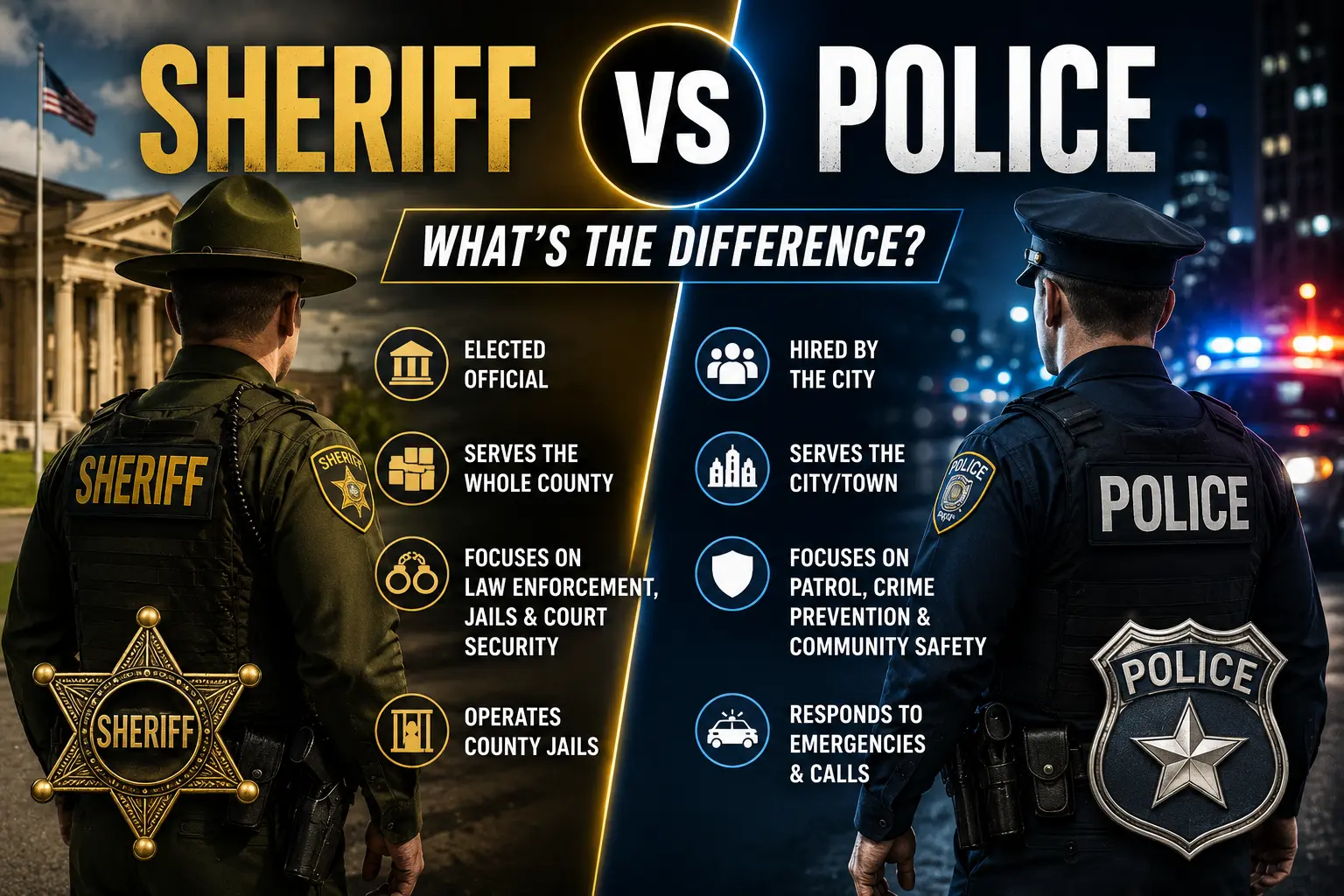
Sheriff vs police is a common comparison because both are responsible for public safety and law enforcement. However, they usually work for different agencies and serve different geographic areas.
A sheriff generally leads a county sheriff’s office, while a police chief leads a municipal police department. Their duties can overlap, but their jurisdiction, leadership structure, and responsibilities often differ.
What Is A Sheriff?
A sheriff is generally the elected chief law enforcement official of a county. The sheriff leads the sheriff’s office and oversees its law enforcement operations.
Sheriff’s offices can handle patrol, criminal investigations, arrests, traffic enforcement, and emergency response. Their responsibilities may also include county jail operations and court-related duties.
The exact role varies between states and counties. Some sheriff’s offices provide a broad range of services, while others focus on specific responsibilities.
What Is A Deputy Sheriff?
A deputy sheriff is a sworn law enforcement officer who works for the sheriff’s office. Deputies generally operate under the authority and direction of the sheriff.
Their duties can include patrol, responding to calls, making arrests, serving warrants, and investigating crimes. Some deputies work in specialized areas such as corrections, courts, or civil process.
A deputy sheriff is therefore not the same as the sheriff. The sheriff leads the agency, while deputies carry out many of its daily operations.
Is A Sheriff Elected?
In most jurisdictions, the sheriff is an elected official. Voters in the county typically choose the sheriff for a fixed term.
This differs from most police chiefs, who are generally appointed by a city government or another local authority. The Bureau of Justice Statistics identifies sheriffs as generally elected and police chiefs as generally appointed.
The election structure can vary by state. Some jurisdictions have different arrangements, so local law ultimately determines how the position works.
What Is A Police Officer?
What Does A Police Officer Do?
A police officer is a sworn law enforcement officer who generally works for a city or municipal police department. Officers patrol their assigned areas and respond to calls for service.
Their duties can include enforcing laws, investigating crimes, making arrests, managing traffic incidents, and responding to emergencies. Officers may also assist victims and provide community services.
Larger departments often have specialized divisions. These can include homicide, narcotics, traffic, cybercrime, K-9, SWAT, and other units.
What Is A Police Department?
A police department is generally a municipal law enforcement agency. It serves a particular city, town, village, or municipality.
The department is usually led by a police chief. Unlike a sheriff, the chief is generally appointed rather than directly elected.
Police departments can range from small agencies with only a few officers to large departments with thousands of employees.
Is A Police Chief Elected?
Police chiefs are generally appointed by local government authorities. Depending on the city, the mayor, city manager, city council, or police commission may have appointment authority.
The chief is responsible for managing the department and implementing its policies. The exact reporting structure depends on the municipality.
This creates a key organizational difference between sheriffs and police departments. A sheriff typically answers directly to county voters, while a police chief generally answers to an appointing authority.
Sheriff Vs Police: Main Differences
Jurisdiction
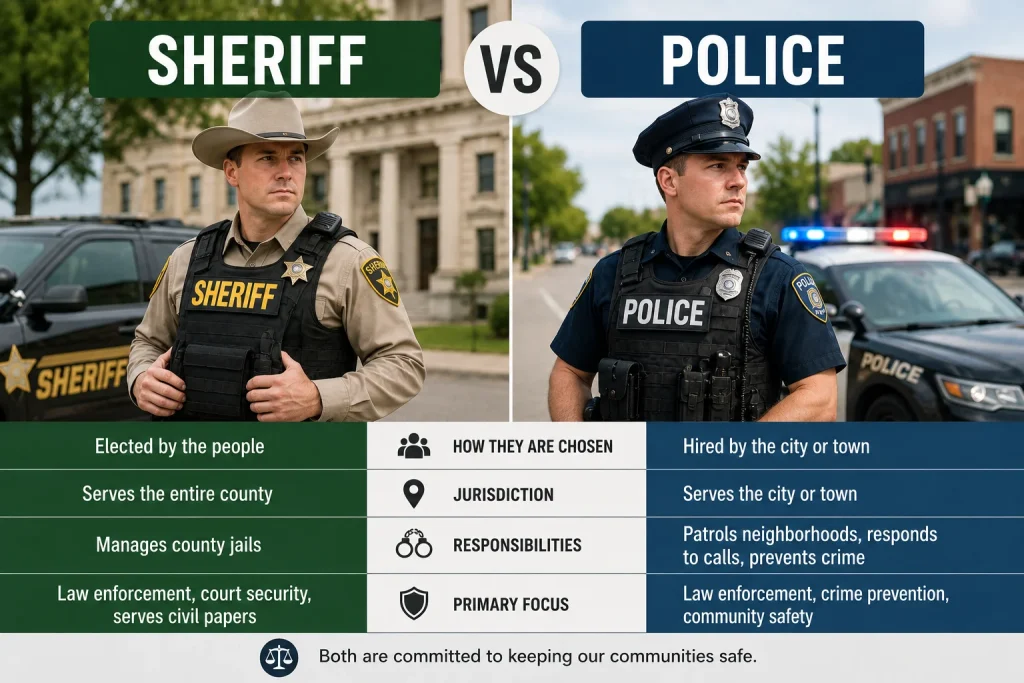
The biggest difference is usually jurisdiction. A sheriff’s office generally has countywide jurisdiction, while a municipal police department normally operates within a particular city or municipality.
This means a sheriff can generally serve areas outside incorporated cities. Police officers usually focus on their department’s municipal boundaries.
The Bureau of Justice Statistics identifies countywide jurisdiction as a common characteristic of sheriff’s offices and city or municipal jurisdiction as a common characteristic of local police departments.
Leadership
Sheriffs and police chiefs have different leadership structures. A sheriff is generally elected, while a police chief is generally appointed.
The sheriff leads the county sheriff’s office. The police chief leads the municipal police department.
Neither position is automatically higher than the other. They normally belong to separate agencies with separate chains of command.
Additional Responsibilities
Sheriff’s offices often have responsibilities that municipal police departments do not. These can include running county jails, providing courthouse security, transporting prisoners, and serving civil papers.
Police departments generally focus more heavily on municipal law enforcement. Their responsibilities center on patrol, emergency response, investigations, traffic enforcement, and community safety.
These distinctions are common rather than universal. State law and local government structures can change which agency handles a particular responsibility.
Sheriff Vs Police: Jurisdiction And Authority
Who Has County Jurisdiction?
The sheriff’s office generally has authority across the county. This includes areas that are not part of an incorporated city.
Countywide jurisdiction can make sheriff’s offices especially important in rural and unincorporated communities. They may provide primary patrol and emergency services in those areas.
However, cities within the county may maintain their own police departments. In those locations, the municipal department can have primary responsibility for ordinary city policing.
Who Has City Jurisdiction?
A city police department generally has jurisdiction within the city or municipality that operates it. Officers patrol streets, respond to calls, and enforce laws within that area.
Their authority can sometimes extend outside city limits. State laws, mutual-aid agreements, fresh pursuit rules, and specific circumstances can affect an officer’s authority.
Therefore, it is too broad to say that police officers can never act outside their city. The applicable law determines the limits.
Who Has More Authority?
A sheriff does not automatically have more authority than a police officer. The two work for different agencies and usually have different jurisdictions.
A sheriff may have countywide authority, while a police department may have primary authority within its city. Geographic scope does not automatically establish a higher rank.
The sheriff is generally the head of the sheriff’s office. The police chief is generally the head of the police department.
Sheriff Vs Police: Duties
Patrol And Emergency Response
Both agencies can provide patrol and emergency response. Deputies may patrol county areas, while police officers typically patrol their municipality.
Both can respond to emergency calls and investigate reported incidents. Dispatchers generally determine which agency should respond based on location and local arrangements.
In areas with overlapping responsibilities, agencies may cooperate. Mutual aid allows one agency to assist another when additional resources are needed.
Criminal Investigations
Sheriff’s offices and police departments can both investigate crimes. Detectives may handle serious offenses, collect evidence, interview witnesses, and work with prosecutors.
A city homicide may normally be investigated by the municipal police department. A homicide in an unincorporated county area may fall under the sheriff’s office.
Major investigations can involve several agencies. State police and federal agencies may also participate when circumstances require broader resources.
Traffic Enforcement
Both sheriffs and police officers can enforce traffic laws when they have appropriate authority. Police commonly handle traffic enforcement inside cities.
Sheriff’s deputies can enforce traffic laws in county areas under their jurisdiction. State police or highway patrol agencies may handle major highways in many states.
The exact division depends on local and state law. Road ownership and agency jurisdiction can also influence which department responds.
Sheriff Vs Police: Jails And Courts
Who Runs The County Jail?
Sheriff’s offices frequently operate county jails. These facilities can hold people awaiting trial and others serving shorter sentences.
Police departments generally do not operate county jails. After an arrest, police may transport or transfer a person to the appropriate detention facility.
Sheriff’s correctional responsibilities are one of the clearest differences between many sheriff’s offices and municipal police departments.
Who Guards The Courthouse?
Sheriff’s offices commonly provide security for county courthouses. Deputies may screen visitors, maintain security, and respond to incidents within court facilities.
They can also transport incarcerated people to court proceedings. These responsibilities vary according to state and local arrangements.
Police departments usually concentrate on municipal law enforcement rather than routine courthouse operations.
Who Serves Legal Papers?
Sheriff’s offices can have civil-process responsibilities in many jurisdictions. These may include serving summonses, subpoenas, eviction notices, and other legal documents.
The exact duties depend on state law and county procedures. Some jurisdictions may use other authorized personnel or private process servers for certain documents.
This is another area where the sheriff’s office can have responsibilities beyond ordinary criminal policing.
Sheriff Vs Police: Arrests And Investigations
Can Both Make Arrests?
Yes. Both sheriffs’ deputies and police officers can generally make lawful arrests when they have the required legal authority.
An arrest usually requires a legally recognized basis, such as probable cause or a valid warrant. The exact rules depend on the circumstances and applicable law.
The agency’s name does not by itself determine whether an arrest is lawful. Jurisdiction and the legal circumstances surrounding the arrest are important.
Can A Sheriff Arrest Someone In A City?
Sometimes. A sheriff’s countywide authority can interact with municipal jurisdiction in different ways.
State law, warrants, mutual-aid agreements, fresh pursuit, and the circumstances of an incident can affect a deputy’s authority inside a city.
Therefore, there is no universal rule that sheriffs can or cannot make arrests within city boundaries.
Can Police Arrest Someone Outside The City?
Sometimes. Police officers can have authority beyond their normal municipal boundaries in certain circumstances.
Examples can include fresh pursuit, mutual aid, executing warrants, or specific state laws. The rules differ between jurisdictions.
For this reason, jurisdiction should be understood as a general operating area rather than an absolute physical boundary in every situation.
Sheriff Vs Police: Training And Careers
Do Sheriffs And Police Receive The Same Training?
Both typically receive formal law enforcement training. Training usually covers subjects such as criminal law, constitutional law, firearms, defensive tactics, emergency response, first aid, and report writing.
Requirements vary by state and agency. A sheriff’s deputy and municipal police officer may therefore attend different academies or receive additional agency-specific training.
Both can also receive continuing education after joining an agency. Specialized assignments often require additional instruction.
Are Deputies Police Officers?
Deputies and police officers are both sworn law enforcement professionals, but they work for different agencies. A deputy sheriff works for a sheriff’s office, while a police officer works for a police department.
Their daily duties can be very similar. Both may patrol, investigate crimes, make arrests, respond to emergencies, and enforce traffic laws.
The main distinction is their agency and normal jurisdiction.
Who Gets Paid More?
There is no universal salary winner. Compensation varies based on location, experience, rank, agency size, overtime, specialized assignments, and local budgets.
A sheriff’s office may offer higher pay in one county, while a nearby police department may offer better compensation. Benefits and retirement plans can also affect the overall package.
Anyone comparing careers should examine specific agencies rather than relying on a general sheriff-versus-police salary claim.
Sheriff Vs Police In Different Communities
Rural Areas
Sheriff’s offices often have a major role in rural communities. Counties can contain large unincorporated areas without their own municipal police departments.
In these areas, deputies may provide routine patrol, emergency response, investigations, and traffic enforcement. The sheriff’s office can effectively serve as the primary local law enforcement agency.
Some communities also contract with sheriff’s offices for additional policing services.
Cities
Cities commonly operate their own police departments. These departments can provide dedicated services within municipal boundaries.
Large cities may have extensive patrol divisions and specialized investigative units. Their size can allow them to maintain teams dedicated to specific types of crime.
A sheriff’s office may still operate elsewhere in the same county. The two agencies can cooperate when incidents cross jurisdictional boundaries.
Unincorporated Areas
Unincorporated areas do not belong to a municipality. They often rely on county government for law enforcement services.
This is where the sheriff’s office can have a particularly important role. Deputies may provide the primary law enforcement presence in these communities.
The arrangement can differ depending on state law and county government structure.
Sheriff Vs Police: Common Misconceptions
Is A Sheriff Higher Than A Police Officer?
Not necessarily. A sheriff is generally the elected head of a county sheriff’s office, while a police officer is a sworn employee of a municipal police department.
The two positions exist within different organizational structures. A sheriff is not normally the direct supervisor of city police officers.
Are Sheriffs And Police The Same?
No. Both are law enforcement agencies, but they generally serve different jurisdictions and can have different responsibilities.
Sheriff’s offices often handle countywide policing and additional court or jail duties. Police departments generally focus on municipal law enforcement.
Is A Deputy The Same As A Police Officer?
They are different job titles within different agencies, but their daily law enforcement duties can overlap significantly.
A deputy works for a sheriff’s office. A police officer works for a police department.
Both can be sworn officers with arrest authority.
Sheriff Vs Police Compared With Other Terms
Why Titles Can Be Confusing
Law enforcement titles can sound similar while describing different positions. The same issue appears in many comparisons where related terms have different responsibilities.
For example, understanding the difference between a sheriff and police requires looking at jurisdiction, leadership, and agency structure rather than the names alone.
The same method can help with other comparisons. The important question is what each term actually means and how it functions.
Comparing Different Systems
Not every comparison involves two versions of the same thing. Some involve separate systems with different purposes, responsibilities, or rules.
For example, annulment and divorce both involve the end of a marital relationship, but they have different legal purposes and requirements.
Sheriff and police work similarly as a comparison. Both provide law enforcement, but their organizational structures and normal jurisdictions differ.
Understanding The Practical Difference
The easiest way to understand sheriff versus police is to focus on where they normally operate and what their agencies handle.
A sheriff’s office generally serves the county, while a police department generally serves a municipality. Sheriff’s offices also frequently handle jails and court-related duties.
This practical distinction is more useful than trying to determine which agency is simply more powerful.
FAQs
What Is The Main Difference Between A Sheriff And Police?
A sheriff generally leads a county law enforcement agency, while police officers usually work for a municipal police department. Sheriffs generally have countywide jurisdiction.
Is A Sheriff Higher Than A Police Officer?
No. A sheriff and a police officer usually belong to separate agencies and chains of command. A sheriff is generally the head of the county sheriff’s office.
Is A Sheriff A Police Officer?
A sheriff is a sworn law enforcement official, but the position is distinct from a municipal police officer. The sheriff generally leads the county sheriff’s office.
What Is A Deputy Sheriff?
A deputy sheriff is a sworn law enforcement officer who works for a sheriff’s office. Deputies can perform patrol, investigations, arrests, and other law enforcement duties.
Who Has More Authority, A Sheriff Or Police?
Neither is automatically more powerful. Their authority depends on state law, jurisdiction, agency responsibilities, and the circumstances of an incident.
Who Runs The County Jail?
Sheriff’s offices commonly operate county jails, although the exact arrangement varies by jurisdiction. Municipal police departments generally do not operate county jails.
Can A Sheriff Arrest Someone In A City?
Sometimes. State law, warrants, mutual-aid agreements, fresh pursuit, and other circumstances can affect a sheriff’s authority inside city limits.
Can Police Arrest Someone Outside Their City?
Sometimes. Police officers may have authority outside their normal jurisdiction under specific laws or circumstances.
Is A Sheriff Elected?
In most jurisdictions, yes. Sheriffs are generally elected by county voters, although the precise system varies by state.
Who Should You Call In An Emergency?
Call 911 for an emergency. Dispatch will generally determine which law enforcement agency should respond based on the location and circumstances.
Final Takeaways
The main difference between a sheriff and police is their agency structure and normal jurisdiction. A sheriff generally leads an elected county law enforcement agency, while a police chief generally leads an appointed municipal police department. Sheriff’s offices often serve county areas, including unincorporated communities, while city police departments normally focus on their municipalities.
Both sheriffs’ deputies and police officers can patrol, investigate crimes, respond to emergencies, enforce traffic laws, and make lawful arrests. Sheriff’s offices often have additional responsibilities involving county jails, courthouse security, prisoner transportation, and civil process. However, these duties vary between states and counties.
Neither a sheriff nor a police officer is automatically more powerful than the other. Their authority depends on state law, jurisdiction, and the circumstances of each situation. For everyday purposes, the easiest distinction is to think of the sheriff as county-level law enforcement and police as municipal-level law enforcement, while remembering that local arrangements can create exceptions.
:::
