
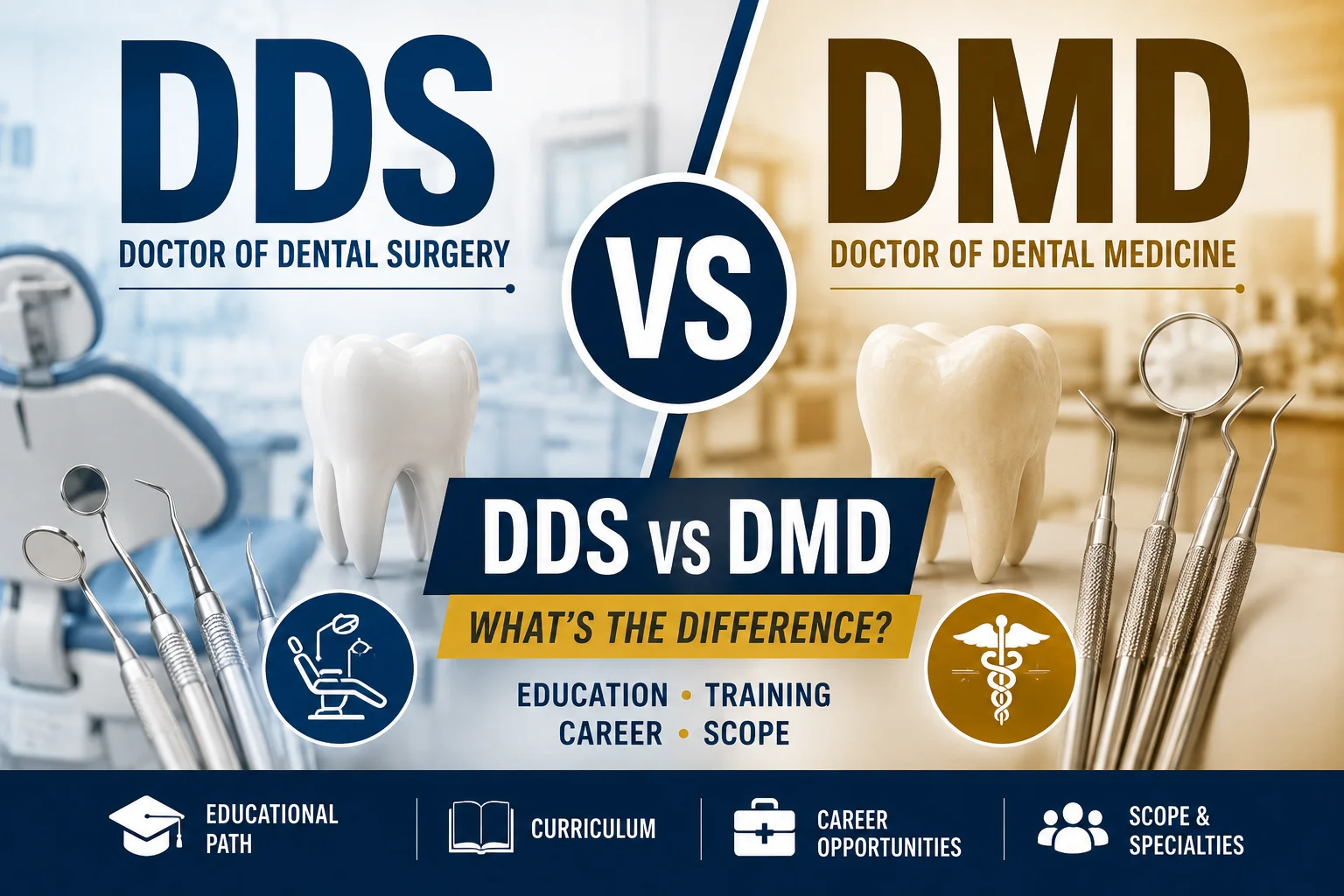
DDS vs DMD is a common question for people comparing dental degrees in the United States. Both credentials qualify graduates to become dentists after completing the required education and licensing process.
DDS means Doctor of Dental Surgery, while DMD means Doctor of Dental Medicine. Despite the different names, both degrees represent equivalent professional dental education in the United States.
What Does DDS Mean?
Doctor Of Dental Surgery
DDS stands for Doctor of Dental Surgery. It is one of the two professional dental degrees awarded by dental schools in the United States.
The word “surgery” can make DDS sound more specialized than DMD. However, the title does not mean DDS dentists receive more surgical training.
A DDS graduate receives training in general dentistry, including diagnosis, prevention, restorative treatment, and various dental procedures.
History Of The DDS Degree
The DDS degree has a long history in American dental education. The Baltimore College of Dental Surgery awarded the first DDS degree in 1840.
The degree title became established as one of the standard ways American dental schools identified their professional dental graduates. Many schools continue using DDS today.
The name is therefore largely historical. It does not indicate that a DDS dentist has a higher level of surgical training than a DMD dentist.
What Can A DDS Dentist Do?
A licensed DDS dentist can generally provide a broad range of general dental services. These can include examinations, fillings, crowns, extractions, root canals, dentures, and preventive care.
The exact scope depends on state law and the dentist’s license. Dentists can also pursue additional education for specialized procedures.
A DDS graduate can become an orthodontist, periodontist, endodontist, oral surgeon, or another dental specialist after completing the required postgraduate training.
What Does DMD Mean?
Doctor Of Dental Medicine
DMD stands for Doctor of Dental Medicine. Some institutions describe it as Doctor of Medicine in Dentistry.
DMD is the second major professional dental degree used in the United States. It is equivalent to the DDS degree for dental education and professional practice.
The different wording can create confusion for patients. The degree name itself does not mean a DMD dentist has more medical training than a DDS dentist.
History Of The DMD Degree
Harvard introduced the DMD designation in 1867. Harvard School of Dental Medicine became the first U.S. dental school to award the DMD degree.
The DMD title was influenced by the school’s connection with medical education. Other schools continued using the traditional DDS designation.
Both titles have remained in use ever since. Their historical differences do not create a meaningful difference in modern dental qualifications.
What Can A DMD Dentist Do?
A licensed DMD dentist can generally provide the same types of general dental treatment as a licensed DDS dentist.
This can include dental examinations, fillings, crowns, bridges, extractions, root canals, preventive treatment, and other procedures permitted by state law.
A DMD dentist can also pursue postgraduate specialty education. The degree title does not restrict the dentist to a particular type of treatment.
DDS Vs DMD: Main Differences
Degree Name
The most obvious difference is the name of the degree. DDS means Doctor of Dental Surgery, while DMD means Doctor of Dental Medicine.
Both are professional doctoral degrees for dentists. The different titles come from the historical choices made by individual dental schools.
The American Dental Association states that DDS and DMD graduates receive the same education and that the degrees have the same curriculum requirements.
Education
DDS and DMD programs follow the same fundamental standards for dental education. Accredited dental schools must meet requirements established by the Commission on Dental Accreditation.
Dental students study subjects such as anatomy, physiology, pathology, pharmacology, oral health, dental materials, diagnosis, and clinical treatment.
Individual schools can organize their courses differently. However, the degree title does not make one program inherently more advanced.
Licensing
Both DDS and DMD graduates can become licensed dentists. State licensing requirements generally recognize either degree when it comes from an appropriately accredited dental program.
Applicants must also satisfy other licensing requirements. These can include written examinations, clinical assessments, background requirements, and state-specific conditions.
The degree letters after a dentist’s name therefore do not determine whether the dentist can practice. The state license does.
DDS Vs DMD: Are They The Same?
Equivalent Professional Degrees
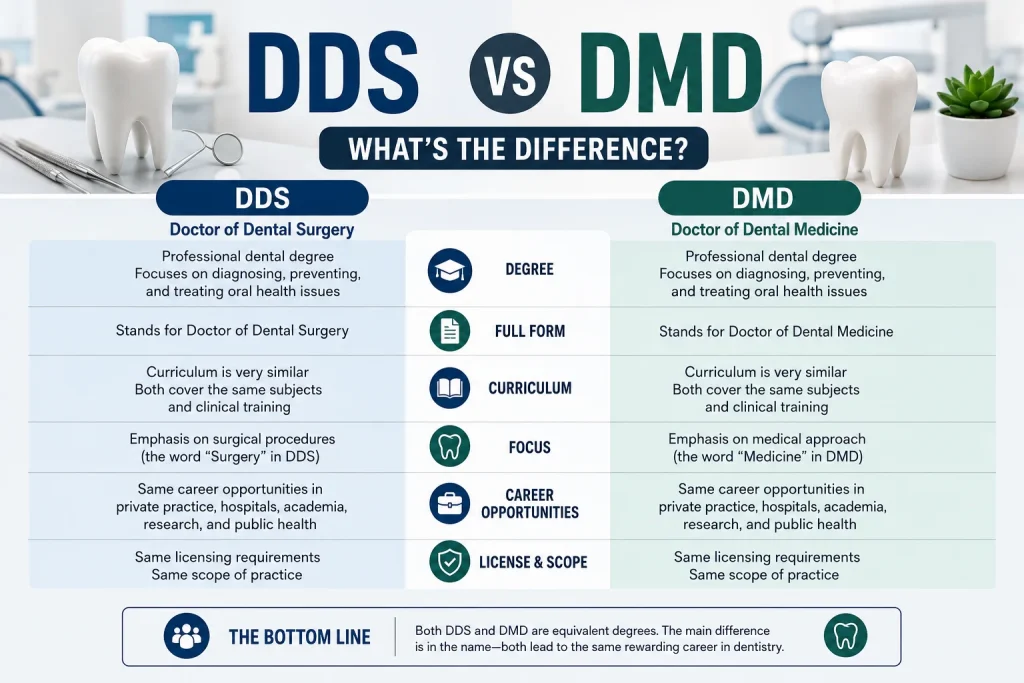
For practical purposes, DDS and DMD are equivalent dental degrees in the United States. Both prepare graduates for general dental practice after licensing.
The American Dental Association directly explains that there is no difference between the two degrees in terms of education. The main distinction is the name chosen by the dental school.
This means patients should not assume one credential represents a higher level of dental education.
Same Dental School Length
Traditional dental school programs generally take four years after the required undergraduate preparation. Both DDS and DMD students complete extensive classroom, laboratory, and clinical training.
Some universities offer different pathways or combined programs. These can change the overall timeline without changing the basic meaning of DDS or DMD.
The degree abbreviation does not tell you how long a particular dentist spent in school. Looking at the individual’s education history provides more useful information.
Same General Dental Practice
A properly licensed DDS and DMD dentist can generally provide the same categories of general dental care.
Both can diagnose oral conditions, treat cavities, perform extractions, restore damaged teeth, and provide preventive services.
The exact scope is controlled by state law and professional licensing. It is not determined simply by whether the dentist has DDS or DMD after their name.
DDS Vs DMD: Specialties And Advanced Training
Can A DDS Become A Specialist?
Yes. DDS graduates can apply for postgraduate dental specialty programs.
Specialties can include orthodontics, periodontics, endodontics, prosthodontics, pediatric dentistry, and oral and maxillofacial surgery.
The specialty training provides advanced knowledge and clinical skills beyond general dental school. The initial DDS designation does not prevent a dentist from pursuing any recognized specialty.
Can A DMD Become A Specialist?
Yes. DMD graduates can also pursue postgraduate dental specialties.
A DMD dentist can become an orthodontist, endodontist, periodontist, prosthodontist, pediatric dentist, or oral and maxillofacial surgeon after completing the required training.
This is another reason the degree title should not be used to judge a dentist’s level of expertise. Specialty training is a separate part of the dentist’s education.
Does DDS Mean More Surgical Training?
No. DDS does not automatically mean more surgical training.
General DDS and DMD programs both provide clinical training that can include surgical dental procedures. More advanced surgery usually requires additional specialty education.
For example, oral and maxillofacial surgeons complete dedicated postgraduate training after dental school.
DDS Vs DMD: Which Is Better?
Is DDS Better Than DMD?
No. A DDS is not inherently better than a DMD.
Both degrees meet the professional education requirements for dentists when awarded by properly accredited programs. The American Dental Association treats the two designations as equivalent.
A dentist’s actual experience and training are more relevant when evaluating professional quality.
Is DMD Better Than DDS?
No. DMD is not a higher version of DDS.
The word “Medicine” in DMD does not mean that the dentist is an MD or has a broader medical license.
DMD simply represents another historical naming convention for the same type of professional dental degree.
What Should Patients Look For?
Patients should focus on the dentist’s license, experience, specialty training, treatment needs, and communication skills.
For complex procedures, checking whether the dentist has specific experience with that treatment can be more useful than comparing DDS and DMD.
Location, insurance, availability, technology, office standards, and patient reviews can also influence the decision.
DDS Vs DMD: Salary And Careers
Do DDS Dentists Earn More?
There is no general salary advantage associated with holding a DDS degree.
Dental income can depend on location, experience, practice ownership, specialty, employment arrangement, working hours, and patient volume.
A DDS dentist and DMD dentist in similar positions can therefore earn similar amounts.
Do DMD Dentists Earn More?
A DMD does not automatically result in a higher salary.
Income differences usually come from career choices and professional circumstances rather than the degree title.
For example, a specialist may earn differently from a general dentist regardless of whether their original dental degree was DDS or DMD.
Career Opportunities
Both degrees can lead to general dentistry, private practice, public health, research, teaching, and specialty training.
Graduates can work in different healthcare settings depending on their interests and qualifications.
The letters DDS or DMD do not limit the career path by themselves.
DDS Vs DMD Compared With Other Professional Terms
Why Similar Terms Can Be Confusing
Professional abbreviations can make related qualifications appear more different than they actually are. The same issue occurs in other comparisons involving specialized terminology.
For example, manhua vs manhwa compares two forms of Asian comics that can seem similar while having important differences in origin and terminology.
DDS and DMD are different because their distinction is mostly historical. Their modern educational and professional roles are substantially the same.
Education And Professional Titles
Not every professional title tells you exactly what a person does. Some abbreviations describe qualifications, while others identify a specialty or professional role.
A comparison such as CCU vs ICU shows how two healthcare settings can overlap while serving different purposes.
DDS and DMD do not work that way. They are two names for equivalent professional dental degrees rather than separate levels of dental practice.
Looking Beyond The Name
The letters after a professional’s name provide useful information, but they do not tell the whole story.
A dentist’s specialty, experience, training, license, and services can provide much more useful information when choosing care.
This is similar to understanding the difference between a mouth breather and nose breather, where the practical distinction matters more than simply recognizing the terminology.
FAQs
What Is The Difference Between DDS And DMD?
DDS means Doctor of Dental Surgery, while DMD means Doctor of Dental Medicine. In the United States, both are equivalent professional dental degrees.
Is A DDS Better Than A DMD?
No. Neither degree is inherently better, and both provide equivalent professional dental education when awarded by an accredited program.
Is A DMD A Medical Doctor?
No. DMD is a dental doctorate, not an MD medical degree. A DMD is a dentist who has completed professional dental education and licensing requirements.
Does DDS Mean More Surgical Training?
No. The word “Surgery” is part of the historical degree name. It does not mean DDS dentists receive more advanced surgical training than DMD dentists.
Do DDS And DMD Dentists Have The Same Training?
Yes, they receive equivalent professional dental education. Individual schools can structure courses differently, but the degree titles do not represent different education levels.
Can A DDS Become A Specialist?
Yes. DDS graduates can complete postgraduate training in specialties such as orthodontics, endodontics, periodontics, and oral surgery.
Can A DMD Become A Specialist?
Yes. DMD graduates have the same opportunity to pursue recognized dental specialties after completing dental school.
Do DDS Dentists Earn More Than DMD Dentists?
No general salary difference exists based solely on the degree title. Earnings depend more on specialty, experience, location, practice ownership, and other career factors.
Which Degree Should A Patient Look For?
Patients generally do not need to choose between DDS and DMD based on the abbreviation. Experience, licensing, specialty training, treatment needs, and professional reputation are more relevant.
Why Do Some Dentists Have DDS And Others Have DMD?
Different dental schools historically chose different degree names. DDS means Doctor of Dental Surgery, while DMD means Doctor of Dental Medicine, and both remain recognized professional dental degrees.
Final Takeaways
DDS and DMD are two names for equivalent professional dental degrees in the United States. DDS stands for Doctor of Dental Surgery, while DMD stands for Doctor of Dental Medicine or Doctor of Medicine in Dentistry. The different titles developed from different historical traditions, with the DDS designation dating back to the early American dental profession and Harvard introducing the DMD designation in 1867.
Neither degree is better, more advanced, or more respected than the other. Both prepare graduates for general dental practice after completing accredited education and state licensing requirements. Both DDS and DMD dentists can also pursue postgraduate specialty training and provide a wide range of dental services within their legal scope of practice.
For patients, the degree abbreviation should not be the deciding factor when choosing a dentist. Experience, specialty training, licensing, treatment needs, communication, and the dentist’s professional record are much more useful factors. In simple terms, DDS vs DMD is mainly a difference in name and history, not quality or level of dental education.
