
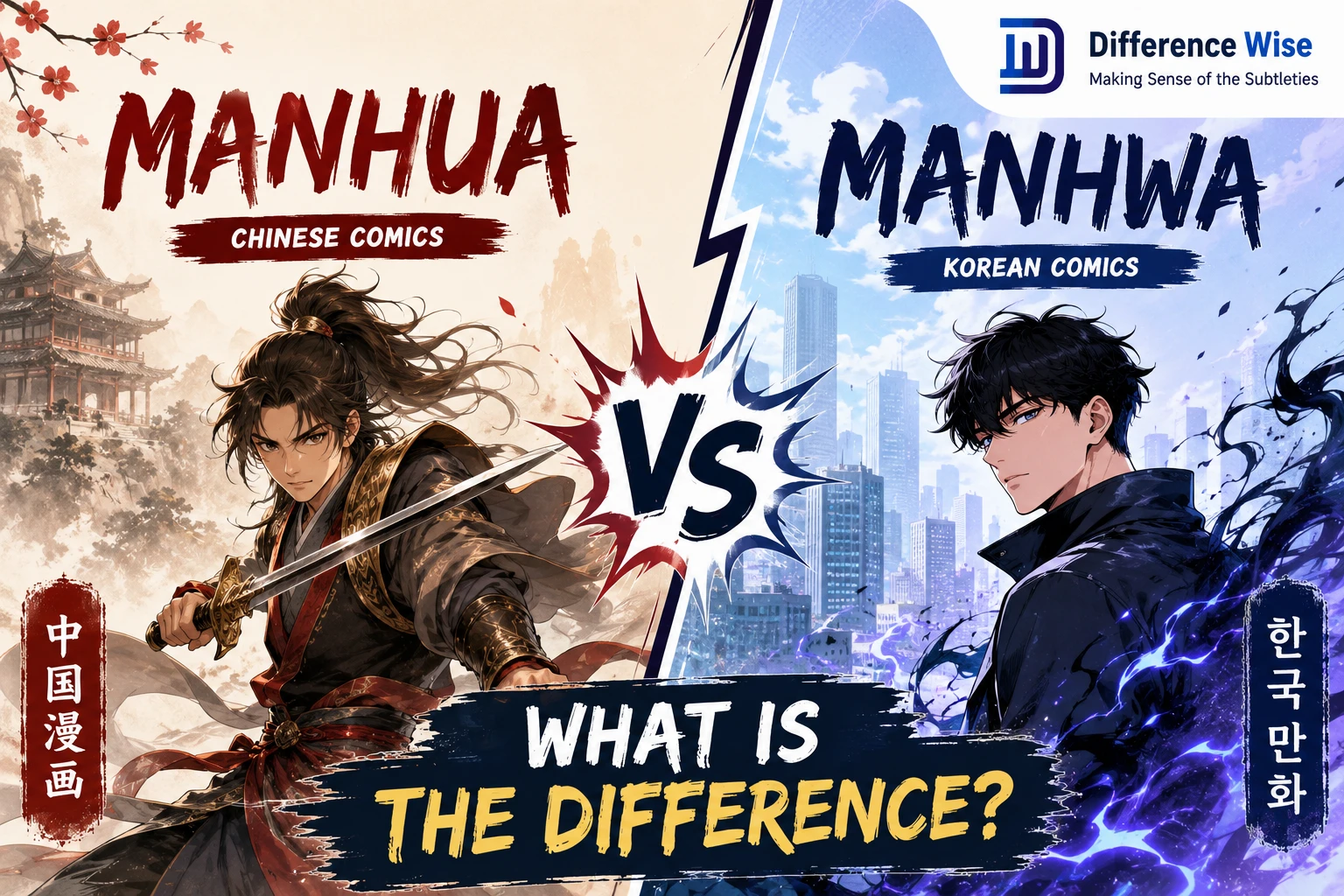
Manhua vs manhwa can be confusing because both terms describe Asian comics and sound remarkably similar. However, they come from different languages and comic traditions.
Manhua generally refers to Chinese comics, while manhwa refers to Korean comics. Their formats, genres, and digital styles can overlap, but their origins differ.
What Does Manhua Mean?
Manhua Comes From Chinese Comic Traditions
Manhua is the common term for Chinese-language comics. It is mainly associated with China, Hong Kong, Taiwan, and other Chinese-language publishing communities.
The term uses Chinese characters that are also related to the words manga and manhwa. Each language gives those characters a different pronunciation.
Manhua can cover many types of comics. These include printed works, newspaper cartoons, graphic stories, web comics, fantasy series, romance, and historical fiction.
How Did Manhua Develop?
Modern Chinese manhua grew through newspapers, magazines, illustrated publications, and political cartoons.
Shanghai became an important center for Chinese cartoon publishing during the early twentieth century. Publications mixed cartoons with photographs, commentary, advertisements, and social observations.
The 1928 magazine Shanghai Manhua is an important example from this period. It helped establish manhua as a recognizable form of modern Chinese cartoon culture.
Today, manhua also has a strong digital presence. Online platforms have made Chinese comics available to readers across many countries.
What Genres Are Common In Manhua?
Manhua covers a wide range of genres, although several themes appear frequently in popular international releases.
Cultivation stories are particularly recognizable. These often involve characters developing supernatural abilities through training, martial arts, spiritual practice, or mystical systems.
Wuxia and xianxia-inspired stories also appear often. Romance, historical fantasy, reincarnation, adventure, comedy, and supernatural fiction are also common.
What Does Manhwa Mean?
Manhwa Comes From Korean Comics
Manhwa is the Korean word for comics. Outside Korea, it usually refers to comics created within the South Korean comic industry.
Like manhua, manhwa can describe both traditional print comics and modern digital works.
The Korean term is written 만화. Its linguistic history is connected to the same Chinese characters that influenced the terms manga and manhua.
How Did Modern Manhwa Develop?
Korean manhwa developed through newspapers, magazines, books, and dedicated comic-reading spaces.
The industry changed significantly as Korean comics moved online during the 1990s and early 2000s.
Major internet portals helped turn digital comics into a major part of Korean popular culture. This development eventually produced the modern webtoon format.
Webtoons are designed for digital screens, particularly smartphones. Their vertical layout lets readers scroll continuously instead of turning physical pages.
What Genres Are Common In Manhwa?
Modern manhwa covers romance, fantasy, action, thriller, comedy, horror, drama, and historical fiction.
Regression and reincarnation stories are also popular. Dungeon stories and game-inspired plots have become especially visible among international readers.
Romance webtoons often focus on relationships, identity, family conflicts, workplace settings, and social issues.
Manhua Vs Manhwa: What Are The Main Differences?
Where Do Manhua And Manhwa Come From?
The clearest difference is geographic and cultural origin.
Manhua is associated with Chinese-language comic traditions. Manhwa is associated with Korean comic traditions.
This distinction is more reliable than visual appearance. Both can use similar digital coloring, character designs, panel layouts, and fantasy themes.
A colorful comic with anime-influenced artwork is not automatically manhwa. Likewise, a martial arts story is not automatically manhua.
How Do Their Languages Differ?
Manhua uses Chinese-language traditions, including both Simplified Chinese and Traditional Chinese depending on the publishing region.
Manhwa uses Korean. The Korean alphabet, Hangul, gives original Korean manhwa a clear linguistic identity.
The similar names can cause confusion because the three terms, manga, manhua, and manhwa, share related historical linguistic roots.
However, they identify different comic traditions when used in their modern forms.
How Do Their Reading Directions Differ?
Reading direction can vary depending on the publication format and market.
Modern Korean manhwa commonly reads from left to right. Webtoons are usually arranged vertically, allowing readers to scroll from the top downward.
Manhua can also use left-to-right layouts, particularly in modern digital editions. Older Chinese publishing traditions may use different page arrangements.
Therefore, reading direction should not be treated as the main test.
The comic’s country or cultural publishing origin gives you a much stronger answer.
Manhua Vs Manhwa: Art Style And Format
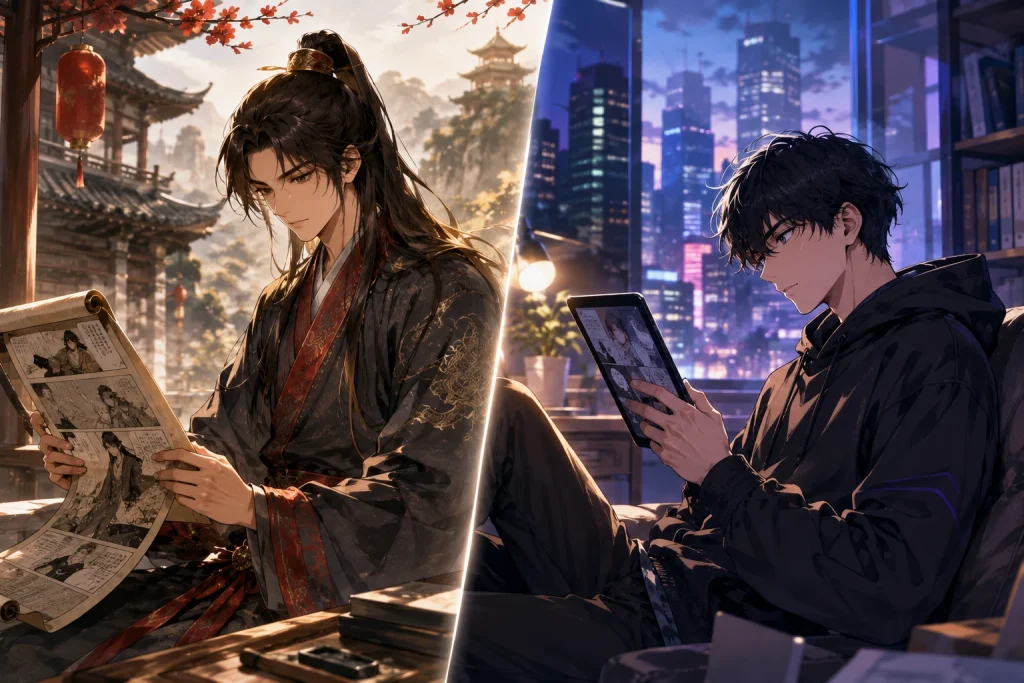
Does Manhua Have A Specific Art Style?
There is no single art style shared by every manhua.
Many popular digital manhua use bright colors, detailed backgrounds, expressive characters, and fantasy-focused artwork.
Chinese historical clothing, architecture, mythology, martial arts, and traditional cultural elements may influence the visual presentation.
However, modern artists use many different approaches. Some works look highly realistic, while others use simple or heavily stylized designs.
Does Manhwa Have A Specific Art Style?
Manhwa also has no single fixed visual style.
Modern webtoons often use digital coloring, cinematic framing, expressive faces, and carefully spaced scenes.
Vertical scrolling gives creators more control over pauses and reveals. It can also create large gaps between scenes for dramatic effect.
Some webtoons use animated effects, sound, or three-dimensional elements. These features are easier to present through digital platforms than traditional printed pages.
Is Webtoon The Same As Manhwa?
Not exactly.
Manhwa describes Korean comics, while webtoon describes a digital comic format. The two terms overlap because South Korea became a major force in webtoon publishing.
A printed Korean comic can be manhwa without being a webtoon. A digital comic can be a webtoon because of its format.
This distinction helps explain why people sometimes use the two terms as though they mean the same thing.
Manhua Vs Manhwa: Popular Examples
Which Popular Stories Are Manhua?
Tales of Demons and Gods is a well-known Chinese fantasy manhua. Its story includes reincarnation, cultivation, supernatural abilities, and martial arts.
Soul Land is another major Chinese fantasy title. It combines supernatural powers, adventure, combat, and character progression.
The King’s Avatar takes a different approach. It focuses on professional gaming and esports rather than traditional cultivation themes.
These examples show how broad manhua can be.
Which Popular Stories Are Manhwa?
Solo Leveling is one of the most recognizable modern Korean manhwa titles. It combines hunters, dungeons, action, fantasy, and character progression.
Tower of God is a fantasy series built around a mysterious tower and a series of challenges.
True Beauty focuses heavily on romance, appearance, identity, and social relationships.
Lookism explores appearance, identity, school life, social status, and violence.
These titles also show the wide range of subjects found within modern Korean comics.
Is Solo Leveling Manhua Or Manhwa?
Solo Leveling is manhwa because it originated as a Korean web novel before receiving a Korean webtoon adaptation.
Its Korean origin places it within the manhwa category. Its vertical digital presentation also makes it a well-known webtoon.
This example is useful because many international readers discover Korean comics through their webtoon format.
How Are Manhua And Manhwa Similar?
Do Both Use Digital Color?
Yes, many modern examples use full-color digital artwork.
This is especially common with web-based releases because color works well on smartphones, tablets, and computer screens.
However, color alone cannot tell you whether a comic is manhua or manhwa.
Do Both Share Similar Genres?
Yes. Romance, fantasy, action, reincarnation, supernatural stories, historical settings, and adventure appear in both categories.
This overlap has increased as creators respond to international reading trends.
A reader who enjoys one category can easily find similar themes in the other.
Are Their Stories Influenced By Popular Culture?
Both industries draw from local history, mythology, folklore, modern entertainment, and international storytelling trends.
Chinese comics may feature cultivation systems, Chinese mythology, wuxia, or xianxia influences.
Korean comics may feature regression, dungeon systems, Korean social settings, gaming concepts, and modern romance themes.
These patterns are useful clues, but they are not strict rules.
Manhua Vs Manhwa: Which One Should You Read?
When Should You Try Manhua?
Manhua may suit readers who enjoy cultivation, Chinese mythology, martial arts, historical fantasy, or long-running adventure stories.
It can also be a good choice if you enjoy detailed fantasy worlds and supernatural power systems.
Popular titles cover many other genres, so there is no need to limit manhua to cultivation stories.
When Should You Try Manhwa?
Manhwa may appeal to readers who enjoy Korean romance, fantasy, action, thrillers, school drama, or progression-based stories.
Webtoons can also be convenient because their vertical format works well on mobile devices.
Readers who prefer fast visual pacing may enjoy the way many Korean webtoons structure their scenes.
Which Is Better?
There is no universal winner between manhua and manhwa.
Your preference depends on the genres, artwork, pacing, characters, and cultural settings you enjoy.
If you like cultivation and Chinese fantasy, manhua may offer more titles that match your interests.
If you prefer Korean romance, dungeon fantasy, regression stories, or modern webtoons, manhwa may be a better starting point.
For readers who enjoy comparison topics involving different categories, you can also explore CCU vs ICU to see how two related terms can have distinct meanings and uses.
Manhua Vs Manhwa: Quick Comparison
Origin And Language
| Feature | Manhua | Manhwa |
| Main origin | China and Chinese-language regions | South Korea |
| Main language | Chinese | Korean |
| Native term | 漫画 / 漫畫 | 만화 |
| Traditional format | Print, magazines, newspapers | Print, magazines, newspapers |
| Modern format | Digital comics and web comics | Webtoons and digital comics |
Style And Reading Experience
| Feature | Manhua | Manhwa |
| Color | Often full color digitally | Often full color digitally |
| Reading direction | Varies by format | Usually left to right |
| Vertical scrolling | Common in digital releases | Very common with webtoons |
| Common themes | Cultivation, martial arts, fantasy | Romance, fantasy, action, regression |
| Style | Varies widely | Varies widely |
Cultural Influences
Manhua can draw from Chinese mythology, martial arts traditions, historical settings, and classical stories.
Manhwa can draw from Korean history, modern Korean society, romance culture, gaming, fantasy, and contemporary storytelling.
However, neither category is limited to these influences.
For another example of how similar-looking categories can differ in meaning, see whether turquoise is blue or green.
FAQs
Is Manhua Chinese Or Korean?
Manhua is primarily associated with Chinese-language comics. Manhwa is the term associated with Korean comics.
Is Manhwa Chinese Or Korean?
Manhwa is Korean. The term refers to comics from the Korean comic tradition, especially South Korean works in modern international usage.
Are Manhua And Manhwa The Same?
No. They are related terms, but manhua refers to Chinese-language comics while manhwa refers to Korean comics.
Is Solo Leveling A Manhua Or Manhwa?
Solo Leveling is a Korean manhwa. Its digital adaptation is also a Korean webtoon.
Is Manhwa Always A Webtoon?
No. Manhwa includes printed Korean comics as well as digital works. Webtoon describes a digital format rather than the entire manhwa category.
Is Manhua Always Full Color?
No. Many modern digital manhua use full color, but manhua can appear in different visual formats and styles.
Which Is Better, Manhua Or Manhwa?
Neither is automatically better. The best choice depends on your preferred genres, artwork, pacing, characters, and story settings.
Why Do Manhua And Manhwa Sound So Similar?
Their names share related historical roots through Chinese characters. The pronunciation changes between Chinese, Korean, and Japanese.
Final Takeaways
Manhua and manhwa are different comic traditions connected mainly to Chinese and Korean languages and cultures. Their modern digital formats can look similar, which often causes confusion among new readers.
The easiest way to tell them apart is to check their origin rather than their artwork or reading direction. Manhua is associated with Chinese comics, while manhwa is associated with Korean comics and the webtoon industry.
If you enjoy comparing everyday terms, you can also read about Pepcid vs Tums for another useful comparison between two commonly confused products.
