
https://differencewise.com/ccu-vs-icu
Meta Description:
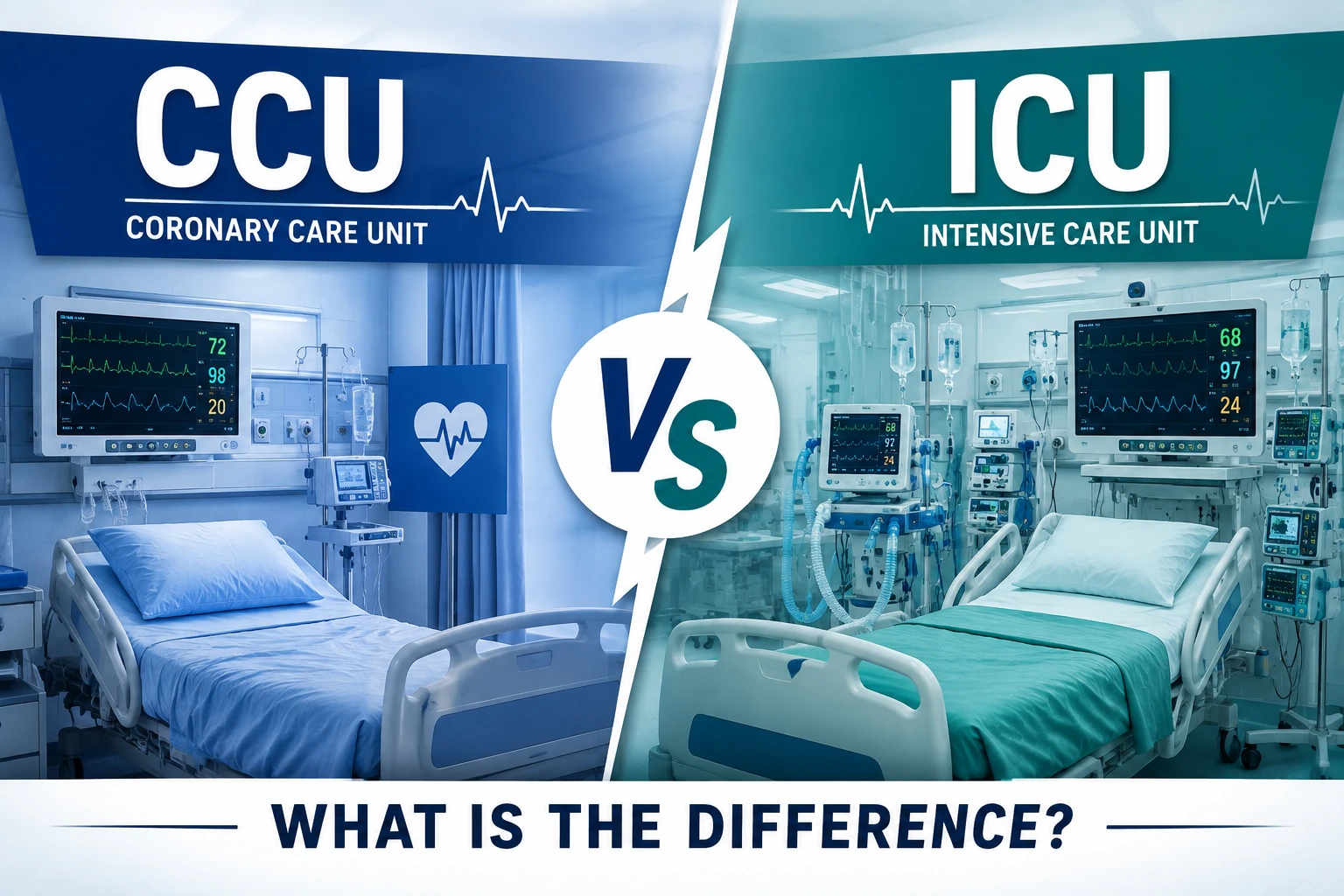
CCU vs ICU can be confusing because both units care for seriously ill patients and provide close medical monitoring.
The main difference is specialization. A coronary CCU focuses on serious heart conditions, while a general ICU treats many types of critical illness.
What Does CCU Mean?
CCU commonly means Coronary Care Unit when referring to specialized cardiac care.
It is a hospital unit designed for patients with serious or unstable heart conditions requiring close observation and treatment.
Patients may need continuous heart rhythm monitoring, cardiac medications, emergency treatment, or other forms of advanced support.
The term originally became associated with specialized care for people experiencing acute heart attacks and dangerous heart rhythms.
What Conditions Are Treated In A CCU?
A coronary care unit may treat several serious cardiovascular conditions.
Common examples include acute myocardial infarction, dangerous arrhythmias, cardiogenic shock, acute heart failure, and other severe cardiac complications.
Patients recovering from certain cardiac procedures may also require this level of observation.
The exact conditions treated depend on the hospital and the equipment available in that unit.
Does CCU Have Another Meaning?
Yes. CCU can also mean Critical Care Unit in some hospitals.
In that situation, CCU may refer to an intensive care service rather than a specifically cardiac unit.
This difference in terminology explains why two hospitals may use CCU differently.
Always check how a particular hospital defines the abbreviation before assuming that CCU means coronary care.
What Does ICU Mean?
ICU stands for Intensive Care Unit.
It is a specialized hospital area for patients who are seriously ill and require continuous monitoring or intensive treatment.
An ICU can care for patients with conditions affecting the heart, lungs, brain, kidneys, liver, or several organs at once.
The goal is to provide close observation and advanced support while the patient’s condition is stabilized.
What Conditions Are Treated In An ICU?
General ICUs treat many forms of life-threatening illness and injury.
Patients may arrive because of severe infections, respiratory failure, major trauma, serious burns, neurological emergencies, organ failure, or complications after major surgery.
Severe cardiac problems can also require ICU care.
For example, someone with serious heart failure may need a ventilator or other support that is available within a general ICU.
What Equipment Is Used In An ICU?
ICUs use equipment that helps staff monitor and support vital body functions.
Common equipment includes cardiac monitors, ventilators, infusion pumps, oxygen systems, feeding tubes, central lines, arterial lines, and urinary catheters.
Some patients may also require dialysis or continuous renal replacement therapy.
The equipment used depends on each patient’s condition and treatment needs.
CCU Vs ICU: What Is The Main Difference?
How Do Their Main Purposes Differ?
The main difference involves specialization.
A coronary CCU is mainly focused on serious cardiovascular problems.
A general ICU provides critical care for patients with many different illnesses and injuries.
However, the difference is not absolute.
Modern cardiac intensive care units can treat patients with respiratory failure, kidney problems, infections, and other serious complications alongside heart disease.
Which Patients Usually Enter A CCU?
Patients with unstable cardiovascular conditions may be admitted to a coronary care unit.
Examples include people with acute coronary syndrome, serious arrhythmias, cardiogenic shock, or severe heart failure.
A patient may also need cardiac intensive care after cardiac arrest or certain complex procedures.
Admission depends on the patient’s condition and the hospital’s available cardiac services.
Which Patients Usually Enter An ICU?

General ICU patients can have many different diagnoses.
One patient may require mechanical ventilation because of severe pneumonia.
Another may need treatment for sepsis, major trauma, neurological injury, or multiple organ problems.
A critically ill cardiac patient can also receive treatment in a general ICU when that setting best matches their needs.
CCU Vs ICU: How Do They Compare?
What Is The Difference In Patient Focus?
CCU care has a strong cardiovascular focus.
Staff pay close attention to heart rhythm, blood pressure, cardiac function, circulation, and other signs of cardiovascular deterioration.
ICU care is broader.
The team may monitor breathing, circulation, neurological function, kidney function, fluid levels, infection, and other body systems.
Both units provide continuous monitoring.
What Is The Difference In Medical Staff?
Both units depend on multidisciplinary medical teams.
A CCU may include cardiologists, critical-care physicians, nurses with cardiac training, respiratory therapists, pharmacists, and other specialists.
An ICU may include intensivists, nurses, respiratory therapists, pharmacists, physical therapists, nutrition specialists, and other professionals.
The exact staffing model varies between hospitals.
Is CCU More Serious Than ICU?
No. One is not automatically more serious than the other.
Both can care for patients facing life-threatening medical problems.
A CCU may treat someone requiring advanced cardiac support.
An ICU may treat someone requiring mechanical ventilation, dialysis, or support for several failing organs.
The patient’s condition determines the severity, not the unit’s name.
CCU Vs ICU: What Equipment Do They Use?
What Equipment Is Common In A CCU?
Cardiac monitoring is central to coronary care.
A CCU may use continuous ECG monitoring, blood pressure monitoring, oxygen monitoring, infusion pumps, defibrillators, ventilators, and emergency medications.
Some cardiac intensive care units also provide advanced circulatory support.
The equipment depends on the hospital’s cardiac services and the patient’s needs.
What Equipment Is Common In An ICU?
An ICU uses many of the same monitoring tools.
Ventilators are especially important when patients cannot breathe adequately without assistance.
Other equipment can include infusion pumps, central venous lines, arterial lines, feeding tubes, dialysis equipment, and emergency cardiac devices.
Not every ICU patient requires all of these machines.
Can A CCU Use A Ventilator?
Yes. Modern coronary and cardiac intensive care units may have ventilators.
A patient with severe cardiac disease can develop respiratory failure and require mechanical ventilation.
Some cardiac intensive care units also manage patients receiving advanced circulatory support.
Therefore, ventilation is not limited to general ICUs.
CCU Vs ICU: How Did These Units Develop?
Why Were Coronary Care Units Created?
Early coronary care units were developed mainly to improve survival after acute heart attacks.
The first units appeared during the early 1960s.
Their original model brought patients together where staff could continuously monitor heart rhythms and quickly respond to dangerous arrhythmias.
Rapid resuscitation and defibrillation became important parts of this specialized approach.
How Has Cardiac Intensive Care Changed?
Cardiac intensive care has expanded significantly since those early units.
Modern cardiac intensive care may involve patients with cardiogenic shock, advanced heart failure, cardiac arrest, severe arrhythmias, and other complex conditions.
Some patients require ventilators, medications that support blood pressure, kidney replacement therapy, or temporary circulatory devices.
This broader role is why many hospitals now use the term Cardiac Intensive Care Unit, or CICU.
Is CICU The Same As CCU?
The terms can overlap, but they are not always identical.
CCU may mean Coronary Care Unit, while CICU specifically means Cardiac Intensive Care Unit.
A modern CICU can provide a wider range of advanced cardiac critical care than the traditional coronary care model.
Hospital terminology still varies, so the exact meaning depends on the facility.
If you enjoy comparing terms with similar names but different meanings, you can also read about Manhua vs Manhwa.
CCU Vs ICU: When Would Someone Need Each?
When Might Someone Need A CCU?
A patient may need coronary care when a serious heart problem requires continuous cardiac observation.
For example, someone with a dangerous arrhythmia may need constant ECG monitoring.
A patient with cardiogenic shock may also need specialized cardiac critical care.
The hospital decides the appropriate unit according to the patient’s condition and available resources.
When Might Someone Need An ICU?
Someone may require ICU care when their condition threatens vital body functions.
Severe pneumonia can cause respiratory failure and require mechanical ventilation.
Sepsis can cause dangerously low blood pressure and organ problems.
Major trauma can also require intensive monitoring and several forms of life support.
Can A Heart Patient Go To A General ICU?
Yes.
A heart patient can receive treatment in a general ICU when that unit has the required staff and equipment.
For instance, a patient with severe heart failure and respiratory failure may need extensive ventilator support.
The best location depends on the patient’s needs rather than the diagnosis alone.
CCU Vs ICU: What Are The Similarities?
Do Both Units Provide Continuous Monitoring?
Yes.
Both units continuously monitor patients who need close medical observation.
Heart rate, blood pressure, oxygen levels, breathing, and other vital signs may be tracked.
The exact monitoring depends on the patient’s illness.
Do Both Units Provide Life Support?
Both units can provide advanced life support.
Ventilators, infusion pumps, emergency medications, and cardiac equipment may be available in both settings.
Some units also provide dialysis or other organ-support treatments.
The available services depend on the hospital.
Can Both Units Treat Cardiac Emergencies?
Yes.
A CCU specializes in cardiac emergencies, but a general ICU can also manage serious heart conditions.
The choice depends on the hospital’s capabilities and the patient’s specific needs.
CCU Vs ICU: Quick Comparison
What Are The Key Differences?
| Feature | CCU | ICU |
| Common meaning | Coronary Care Unit | Intensive Care Unit |
| Main focus | Serious cardiac conditions | Critical illness across many conditions |
| Typical patients | Heart attacks, arrhythmias, heart failure, cardiogenic shock | Sepsis, respiratory failure, trauma, organ failure, serious cardiac illness |
| Monitoring | Strong cardiac focus | Whole-body critical monitoring |
| Heart monitoring | Central | Used when needed |
| Ventilators | Available in many units | Common |
| Cardiac specialists | Often central to care | Consulted when needed |
| Patient scope | Mainly cardiac | Broad |
| Modern related term | CICU | General ICU |
Which Unit Provides More Specialized Care?
A coronary CCU provides more specialized cardiac care.
A general ICU provides broader critical-care services across different medical conditions.
However, some modern CICUs provide highly advanced treatment for patients with severe cardiovascular disease.
The appropriate unit depends on the patient’s condition and the hospital’s clinical resources.
For another comparison involving two commonly confused terms, see whether turquoise is blue or green.
FAQs
Is CCU The Same As ICU?
Not always. When CCU means Coronary Care Unit, it is a cardiac-focused critical-care area. Some hospitals use CCU to mean Critical Care Unit.
What Does CCU Stand For?
CCU commonly stands for Coronary Care Unit. In some hospitals, it can also mean Critical Care Unit.
What Does ICU Stand For?
ICU stands for Intensive Care Unit. It provides intensive treatment and continuous monitoring for seriously ill patients.
Is CCU More Serious Than ICU?
No. Both units can care for critically ill patients. Severity depends on the patient’s condition and required treatment.
Can A Heart Patient Go To The ICU?
Yes. Patients with serious heart conditions can receive care in a general ICU when their treatment needs match that unit’s capabilities.
Can A Non-Heart Patient Go To A CCU?
It depends on the hospital. Modern cardiac intensive care units may treat patients with serious noncardiac problems alongside major cardiovascular conditions.
Does A CCU Have Ventilators?
Many modern cardiac care units have ventilators. Patients with severe cardiac disease may develop respiratory failure and need mechanical breathing support.
What Is The Difference Between CCU And CICU?
CCU commonly means Coronary Care Unit, while CICU means Cardiac Intensive Care Unit. Modern CICUs generally provide broader cardiac critical care.
How Long Do Patients Stay In A CCU?
There is no fixed length of stay. It depends on the patient’s diagnosis, response to treatment, and need for continuous monitoring.
How Long Do Patients Stay In An ICU?
ICU stays vary widely. Some patients leave after a short period, while others require intensive care for weeks.
Final Takeaways
CCU and ICU both provide high-level care for seriously ill patients, but their usual roles differ. A coronary CCU focuses mainly on serious cardiovascular conditions.
A general ICU treats critical illnesses across many medical specialties. However, modern cardiac intensive care can manage complex problems that extend beyond the heart.
The abbreviation CCU also has different meanings between hospitals. Checking the hospital’s terminology is important before assuming that CCU always means Coronary Care Unit.
The best unit for a patient depends on their condition, required treatment, specialist expertise, and available equipment. For another product comparison with two frequently confused options, see Pepcid vs Tums.
