
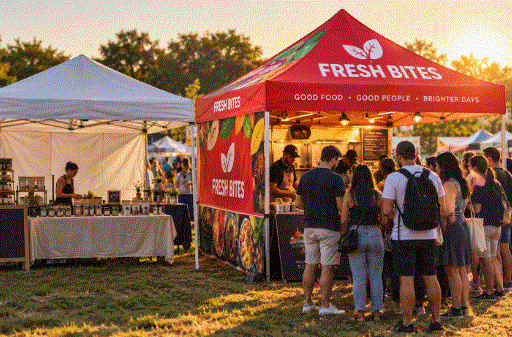
Two stalls at the same market, selling similar things, with the same footfall passing both.
One’s under a plain white canopy with a banner cable tied to the front. The other has its name running along the whole roof, colors matching the brand, visible from about forty meters away before anyone can even see what’s being sold. Guess which one had a queue by ten.
That’s the whole argument for a branded tent in one comparison, really. The first one bought shelter. The second bought shelter and an advertising hoarding and a landmark, all in the same purchase. Most businesses still think of the tent as the first thing only.
How Branded Tents Turn Event Spaces Into Marketing Opportunities
Source AI
- The Tent Is the Ad That Shows Up Physically
Think about where ad money usually goes. Online spots that vanish when the budget stops. Billboards fixed to one roadside for whoever drives past. Print that gets binned. All of it rents attention somewhere specific for a limited time.
On Saturday it’s the farmers market. The weekend after, a school fete. Then a trade show midweek, then a charity do at the month’s end. One canopy, one set of branding, and a completely fresh crowd of faces at every stop. Run that across a year, call it a dozen events, and the cost of reaching each of those crowds works out to pennies. No ad platform comes anywhere near that maths, and none of them let you shake hands with the audience either.
Quality matters here more than people expect, because this thing lives outside. Proper custom tents with printed fabric can keep your branding visible across repeated events, while the right construction and printing help create a more professional presentation. Instent currently offers custom tents in several sizes, including 10×10, 10×15, and 10×20 options.
- Being Findable Is Half the Battle
Four words come up at every busy event ever held. “Where are you? Can’t find you.”
Crowded fields all look the same. Rows of white tops, identical from a distance. Attendees give up hunting and spend their money at whatever happens to be nearest. A branded canopy ends that problem permanently. Colors and a logo readable from across the site mean friends, customers, and people who saw the social post all walk straight to the right spot without directions.
There’s a knock-on effect too. People navigate by landmarks, so a distinctive tent becomes “the blue one near the entrance” in hundreds of private conversations throughout the day. That’s word of mouth built into the physical object. A billboard never gets referenced by name in somebody’s conversation. The tent does, constantly, for free.
- Every Photo Becomes an Ad
Now this is the bit businesses rarely think about until it’s pointed out. Events get photographed. Attendees take pictures, organizers post recap galleries, vendors share their stalls on social media, and local pages cover the day. In all of that imagery, the tent sits in the background doing silent work.
And the reason it works so well is that it doesn’t look like advertising at all. A sponsored post gets scrolled past on sight. A photo a friend took at the market gets looked at properly, with the branding sitting right there in the frame, quietly endorsed by whoever pressed the button. Dozens of images like that can come out of a single decent event. Across a season, the reach adds up to something the business never spent a penny on directly.
- Different Events, Different Jobs for the Same Brand
Sizing comes down to one question. What does each event on the calendar actually need?
For a standard market pitch, the 10×10 handles everything. One person can get it up in minutes, and it fits the allocated space without drama. But add a queue of customers, a trade show stand with displays, or seating for an activation, and suddenly the 10×15 is the smarter buy. The 10×15 custom pop-up tent provides 150 square feet of covered space, giving businesses more room for displays, demonstrations, customer interactions, and equipment than a standard 10×10.
One more thing on print scale, since it gets overlooked. People spot a market stall from roughly thirty meters out but a trade show booth from about ten, so the logo sizing should match whichever distance applies. Print sized for the wrong distance is branding that never gets read.
- It Opens Doors Plain Shelters Can’t
Here’s a blunter way to put it. Some events simply won’t have you looking amateur.
Event organizers vetting vendors look at stall photos first. Sponsorship packages expect a branded setup. Trade shows hand the better positions to exhibitors that look like they belong there. And a corporate client hiring a catering or promotions company will judge the van and the tent long before anyone tastes the food.
None of these doors open for a generic gazebo with a taped-on sign, which flips the usual way of seeing it. That tent isn’t supporting the business’s event activity at all. Companies that treat it that way end up using it every weekend, and the return hides in that constant use.
End Point
Shelter is the cheap part of what a canopy does. The expensive part, the part that pays, is everything else: the brand carried to a new audience every weekend, the landmark people can find and talk about, the free advertising inside every event photo, and the professional presence that unlocks the better events in the first place.
Buy it plain, and it’s a tarp with legs. Buy it branded, and it’s a billboard that travels, works weekends, and never asks for renewal fees. One of those is an expense. The other quietly becomes the hardest-working item in the marketing budget.
