
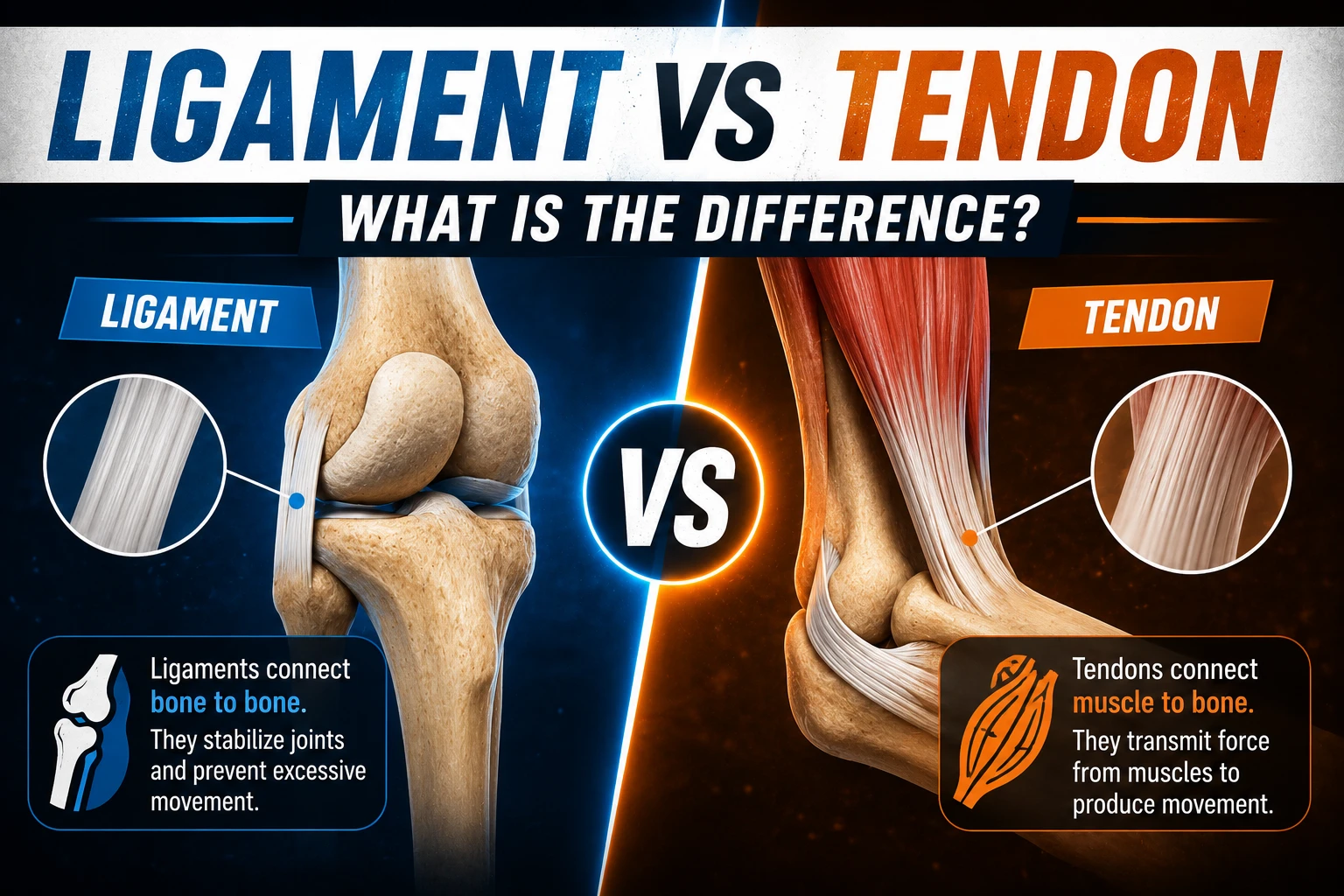
Ligaments and tendons are strong connective tissues that support movement and stability. The main difference is simple: ligaments connect bone to bone, while tendons connect muscle to bone.
Both contain large amounts of collagen and can be injured through sudden force or repeated stress. However, they perform different jobs and have different injury terms, healing patterns, and treatment needs.
What Is A Ligament?
How Do Ligaments Work?
A ligament is a band of strong connective tissue that connects one bone to another. Most ligaments are found around joints, where they help keep bones properly aligned during movement.
Ligaments also limit excessive or abnormal joint movement. They provide support without completely preventing normal movement.
For example, the ligaments in the knee help control how the joint moves. The ankle also depends on several ligaments to maintain stability during walking, running, and other activities.
What Is The Main Function Of A Ligament?
The main function of a ligament is to stabilize a joint. It helps prevent bones from moving too far in directions that could damage the joint.
Ligaments can also help guide normal joint movement. Their structure allows them to withstand tension while providing controlled flexibility.
This makes ligaments important for both stability and movement. They do not normally contract like muscles, but they strongly influence how joints move.
What Are Some Examples Of Ligaments?
The body contains many different ligaments. Some of the best-known examples are the anterior cruciate ligament, posterior cruciate ligament, medial collateral ligament, and lateral collateral ligament.
The ankle also contains several important ligaments. These structures help prevent excessive movement and keep the bones of the ankle properly positioned.
Other ligaments are found in the shoulder, wrist, thumb, spine, and other joints. Each one has a role based on the movement and forces affecting its particular joint.
What Is A Tendon?
How Do Tendons Work?
A tendon is a strong connective tissue structure that connects a muscle to a bone. When a muscle contracts, the tendon transfers that force to the bone.
This force transmission allows movement to occur at joints. Without tendons, muscles would not be able to efficiently transfer their pulling force to the skeleton.
Tendons are therefore an important link between the muscular and skeletal systems. Their strength allows them to handle repeated tension during everyday movement and physical activity.
What Is The Main Function Of A Tendon?
The primary function of a tendon is to transmit force from a muscle to a bone. This allows muscles to move body parts and control joints.
Tendons can also store and release some elastic energy during movement. This is particularly useful during activities such as running and jumping.
Because tendons transfer muscular force, they experience significant mechanical loads. Repeated or excessive loading can contribute to tendon problems.
What Are Some Examples Of Tendons?
The Achilles tendon is one of the body’s best-known tendons. It connects the calf muscles to the heel and helps produce movement of the foot.
The patellar tendon connects the kneecap to the shinbone. It helps transfer force from the quadriceps muscles so the knee can extend.
Other examples include the rotator cuff tendons, biceps tendon, triceps tendon, and various tendons in the hands and feet.
Ligament Vs Tendon: Main Difference
What Does A Ligament Connect?
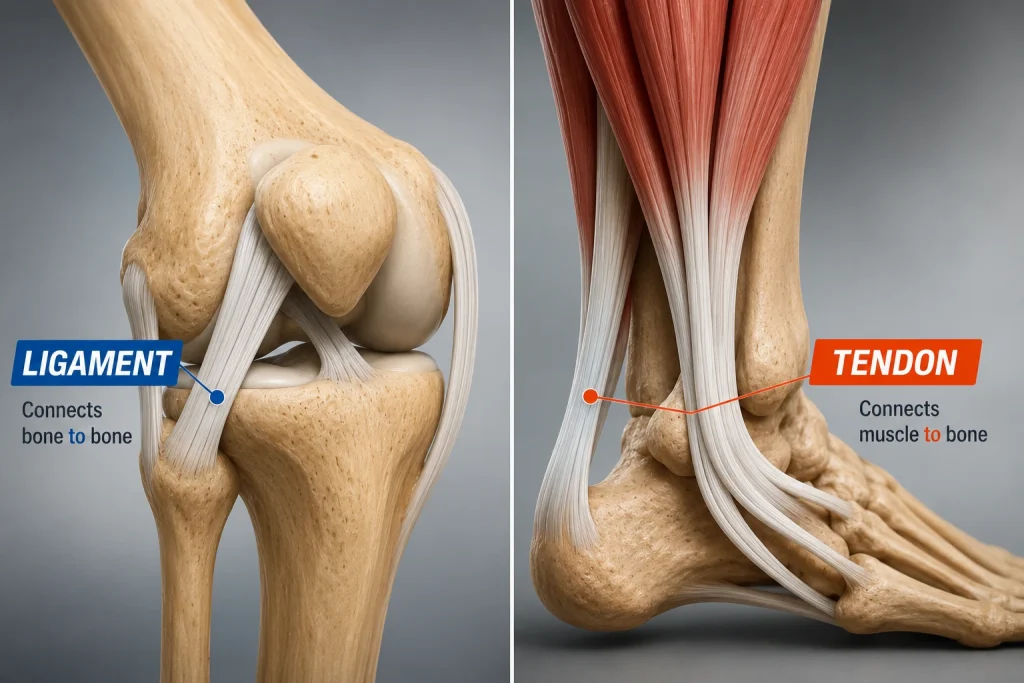
A ligament connects bone to bone. Its main purpose is to support and stabilize a joint while controlling excessive movement.
You can remember the connection as:
Bone → Ligament → Bone
The ligament does not primarily transmit muscle force. Instead, it helps maintain the relationship between bones as a joint moves.
What Does A Tendon Connect?
A tendon connects muscle to bone. Its main purpose is to transfer the force created by muscle contraction.
You can remember the connection as:
Muscle → Tendon → Bone
This connection allows muscular force to move the skeleton. Tendons therefore play a direct role in producing movement.
Why Are They Easy To Confuse?
Ligaments and tendons are both made from strong connective tissue and contain large amounts of collagen. They can also look similar when viewed without detailed anatomical knowledge.
Both structures can become painful, swollen, overstretched, or torn. Their injuries can also occur during similar activities, such as sports, falls, or sudden movements.
The easiest way to tell them apart is to remember what they connect. Ligament means bone to bone, while tendon means muscle to bone.
Both tissues are strong because they need to withstand mechanical forces. Their structures differ because their jobs within the body are not the same.
Movement And Stability
Tendons are closely involved with movement because they transfer muscle force to bones. When you contract a muscle, its tendon carries that force toward the bone.
Ligaments are more closely associated with stability. They help keep a joint within its normal range while still allowing useful movement.
This distinction does not mean ligaments have nothing to do with movement. Instead, they help control movement while tendons help produce it.
Strength And Flexibility
Neither tissue can simply be labeled as stronger in every situation. Their mechanical properties depend on their size, location, structure, and the forces they normally experience.
Tendons are generally designed to transmit substantial tensile forces from muscles to bones. Ligaments are designed to withstand forces that can occur as joints move.
Both tissues can stretch under load. However, excessive stretching can damage their collagen structure and reduce their ability to perform normally.
Ligament Vs Tendon: Structure
What Are They Made Of?
Both ligaments and tendons are dense connective tissues containing substantial amounts of type I collagen. Collagen gives them much of their tensile strength.
They also contain water, proteoglycans, glycoproteins, elastin, and specialized cells. The proportions and arrangement of these components vary between different tissues.
Their microscopic structures are organized into several levels. Collagen molecules form fibrils, which combine into larger fibers and bundles.
How Are Tendon Fibers Arranged?
Many tendon collagen fibers are arranged largely in the direction of the forces they transmit. This organization helps the tendon transfer muscle force efficiently.
The fibers form an organized structure capable of handling repeated tension. This is especially important because tendons can experience substantial loads during exercise.
Tendon structure can vary depending on its location and function. Some tendons also contain specialized regions that help them interact with surrounding tissues.
How Are Ligament Fibers Arranged?
Ligament fibers can have more varied orientations because ligaments often resist forces from different directions. This helps them control complex joint movements.
Their structure allows them to stretch within limits while resisting excessive displacement. Different ligaments have different arrangements based on the joint they support.
This is one reason ligaments cannot simply be treated as identical versions of tendons. Although their materials are similar, their organization reflects their different jobs.
Ligament Vs Tendon: Injuries
What Is A Ligament Sprain?
A sprain is an injury involving a ligament. It usually occurs when a ligament is stretched beyond its normal range or torn.
An ankle sprain is a common example. It can happen when the foot suddenly rolls or twists, placing excessive force on the ankle ligaments.
Symptoms can include pain, swelling, bruising, stiffness, and difficulty using the affected joint. Severe sprains can also cause joint instability.
What Is A Tendon Injury?
Tendon injuries include tendinopathy, tendon inflammation, partial tears, and complete ruptures. They can result from repetitive loading, sudden force, or a combination of factors.
Some tendon conditions develop gradually through repeated stress. Others happen suddenly when a tendon experiences a force that exceeds its capacity.
Common examples include Achilles tendon problems, rotator cuff tendon injuries, and patellar tendon injuries. Symptoms can include localized pain, tenderness, swelling, weakness, and difficulty with movement.
Sprain Vs Strain
A useful terminology rule is sprain for ligament and strain for muscle or tendon. The two terms are often confused because both can result from stretching or tearing.
For example, twisting an ankle and damaging a ligament produces a sprain. Overstretching a muscle or tendon is generally described as a strain.
Tendon injuries can also have more specific names, such as tendinopathy or tendon rupture. The correct term depends on the type and severity of the injury.
Ligament Vs Tendon: Symptoms
Common Ligament Injury Symptoms
A damaged ligament can cause pain around a joint. Swelling and bruising may develop soon after an acute injury.
The joint may also feel unstable or difficult to move. Some people notice a popping sensation when a significant ligament injury occurs.
Symptoms depend on the affected ligament and injury severity. A minor sprain may cause limited discomfort, while a complete tear can produce major instability.
Common Tendon Injury Symptoms
Tendon problems often cause pain near the area where a muscle connects to a bone. The pain may become more noticeable when the associated muscle is used.
Tenderness, swelling, stiffness, and weakness can also occur. Some tendon conditions become painful during repeated activity but improve with rest.
A complete tendon rupture can cause sudden pain and major loss of function. The affected body part may become difficult or impossible to move normally.
Why Symptoms Can Overlap
Both ligament and tendon injuries can cause pain, swelling, stiffness, and reduced function. This makes it difficult to identify the injured structure based on symptoms alone.
An ankle injury is a good example. A single twisting event can affect a ligament, tendon, bone, or several structures at once.
Persistent or severe symptoms should therefore be assessed by an appropriate healthcare professional. Imaging or physical examination may be needed to determine the exact injury.
Ligament Vs Tendon: Healing
Do Ligaments Heal?
Ligaments can heal, but recovery varies greatly between different ligaments and injuries. Location, blood supply, injury severity, and treatment can all affect healing.
Some ligaments have better natural healing capacity than others. Certain ligaments inside joints, including the ACL, have more limited natural healing compared with some other ligaments.
Healing also does not always mean the tissue returns to its original condition. Rehabilitation may be needed to restore strength, stability, movement, and confidence.
Do Tendons Heal?
Tendons can also heal after injury, but the process can be slow. Their relatively limited blood supply and dense collagen structure contribute to lengthy recovery in some cases.
The body’s repair process involves producing and reorganizing collagen. Gradual rehabilitation helps the recovering tendon adapt to mechanical demands.
Severe tendon injuries can require longer treatment and, in some cases, surgery. The appropriate approach depends on the specific tendon and the severity of the damage.
Which Heals Faster?
There is no universal answer because healing varies between specific ligaments and tendons. Different tissues have different blood supplies, structures, injury patterns, and mechanical demands.
Some ligaments heal relatively well, while certain ligaments have limited healing potential. Tendon injuries can also vary from minor irritation to major rupture.
Recovery time therefore should not be judged solely by whether the injured structure is a ligament or tendon. The location and severity of the injury are equally important.
Ligament Vs Tendon In The Knee
Knee Ligaments
The knee contains several major ligaments that help stabilize the joint. The ACL, PCL, MCL, and LCL are among the best-known examples.
The ACL and PCL help control movement between the femur and tibia. The MCL and LCL provide stability against certain sideways forces.
Injuries to these structures are generally described as sprains or tears. Treatment varies depending on the specific ligament, injury severity, activity level, and degree of instability.
Knee Tendons
The knee also contains important tendons. The quadriceps tendon connects the quadriceps muscle to the kneecap, while the patellar tendon continues from the kneecap to the shinbone.
These tendons transfer force from the thigh muscles to the lower leg. This allows the knee to extend during activities such as walking, running, and jumping.
Tendon problems around the knee can develop through repetitive loading. Sudden force can also produce partial or complete tendon tears.
Why The Knee Shows The Difference Clearly
The knee contains both structures in the same general region. However, their jobs remain different.
The ligaments provide stability between bones. The tendons transfer force from muscles to bones so the knee can move.
This makes the knee a useful example when learning the basic difference. A torn ACL is a ligament injury, while a torn patellar tendon is a tendon injury.
Ligament Vs Tendon In The Ankle
Ankle Ligaments
The ankle depends on several ligaments to maintain joint stability. The lateral ankle ligaments are especially common sites of injury.
An ankle sprain often occurs when the foot rolls or twists unexpectedly. This can stretch or tear one or more supporting ligaments.
Symptoms may include pain, swelling, bruising, and difficulty putting weight on the foot. More serious injuries can produce substantial instability.
Ankle Tendons
Several tendons help control movement around the ankle and foot. The Achilles tendon is the best-known example.
The Achilles connects the calf muscles to the heel bone. It helps transfer muscular force so the foot can push against the ground during walking, running, and jumping.
Other ankle tendons help control movements of the foot. Problems involving these structures can develop through repetitive activity or sudden force.
Learn More: Pepcid Vs Tums: What Is The Difference?
Why Ankle Injuries Are Often Confused
Pain after an ankle injury does not automatically mean that a ligament was damaged. Tendons, bones, cartilage, and other structures can also be affected.
A twisting injury commonly causes a ligament sprain, but symptoms can overlap with other problems. The exact cause may require a physical examination.
This is why persistent pain, significant swelling, instability, or inability to bear weight should not be ignored. A healthcare professional can determine whether further evaluation is necessary.
Ligament Vs Tendon In The Shoulder
Shoulder Ligaments
Shoulder ligaments help connect bones and stabilize the shoulder region. They are important because the shoulder allows a very large range of movement.
The shoulder’s mobility creates a tradeoff with stability. Ligaments contribute to keeping the joint controlled while allowing useful movement.
Injuries can occur after falls, impacts, or movements that force the shoulder beyond its normal range. Symptoms depend on which structure has been affected.
Rotator Cuff Tendons
The rotator cuff includes four muscles and their associated tendons. These tendons attach around the upper arm and help move and stabilize the shoulder.
Rotator cuff tendons can develop problems from repetitive overhead activity, age-related changes, or acute injury. Pain and weakness are common symptoms.
A tendon problem can therefore affect both movement and shoulder function. Treatment depends on the type and severity of the injury.
The Main Shoulder Difference
Shoulder ligaments mainly help stabilize the relationship between bones. Rotator cuff tendons connect muscles to bone and help generate and control movement.
Both can be injured during physical activity. Their different anatomical connections explain why they are classified and treated differently.
Ligament Vs Tendon: Strength And Flexibility
Which Is Stronger?
It is not accurate to say that ligaments are always stronger than tendons or vice versa. Their mechanical properties vary according to size, location, structure, and function.
Tendons are built to transmit strong forces from muscles. Ligaments are built to withstand forces that occur around joints.
Both can tolerate substantial tension under normal conditions. However, excessive loading can damage either tissue.
Which Is More Flexible?
Ligaments generally allow more controlled movement within a joint, while tendons are generally designed for efficient force transfer.
This does not mean ligaments are loose or tendons are completely rigid. Both tissues have measurable elasticity and can deform when force is applied.
Their mechanical differences reflect their different purposes. A ligament needs to control joint motion, while a tendon needs to transmit muscle force.
Do Both Contain Collagen?
Yes. Both ligaments and tendons contain large amounts of type I collagen.
The collagen provides much of their tensile strength. However, the arrangement and organization of collagen differ according to the tissue’s function.
This shared material is one reason they can appear similar anatomically. Their connections and mechanical roles are what provide the clearest distinction.
FAQs
What Is The Main Difference Between A Ligament And A Tendon?
A ligament connects one bone to another, while a tendon connects a muscle to a bone. Ligaments mainly help stabilize joints, while tendons transfer muscle force to produce movement.
Are Ligaments And Tendons The Same Thing?
No. They are both strong connective tissues, but they have different anatomical connections and mechanical functions.
What Does A Ligament Connect?
A ligament connects bone to bone. It helps maintain joint stability and limits excessive movement.
What Does A Tendon Connect?
A tendon connects muscle to bone. It transfers the force produced by muscle contraction to the skeleton.
Which Is Stronger, A Ligament Or Tendon?
Neither is universally stronger. Both are adapted to handle the forces associated with their particular functions.
Which Is More Flexible?
Ligaments generally allow controlled joint movement, while tendons are generally stiffer because they need to transfer muscle force efficiently. Both have some elasticity.
What Is A Sprain?
A sprain is an injury involving a ligament. It can involve stretching, partial tearing, or complete tearing of the ligament.
What Is A Strain?
A strain generally refers to an injury involving a muscle or tendon. It can result from overstretching or excessive force.
Does A Ligament Heal?
Ligaments can heal, but their recovery varies by location and injury severity. Some ligaments have better natural healing capacity than others.
Do Tendons Heal?
Yes, tendons can heal after injury. Recovery can be slow, especially after severe or chronic tendon damage.
Which Heals Faster, A Ligament Or Tendon?
There is no universal answer. Healing depends on the specific tissue, location, blood supply, injury severity, and treatment.
Is The ACL A Ligament Or Tendon?
The ACL is a ligament. It connects the femur and tibia and helps stabilize the knee.
Is The Achilles A Ligament Or Tendon?
The Achilles is a tendon. It connects the calf muscles to the heel bone and helps move the foot.
Is The Patellar Tendon A Ligament?
No. The patellar tendon is a tendon that helps transfer force from the quadriceps mechanism to the shinbone.
Is The Rotator Cuff A Tendon?
The rotator cuff consists of four muscles and their tendons. The tendons attach the muscles to the upper arm and help stabilize and move the shoulder.
Can A Ligament Tear?
Yes. Ligaments can partially or completely tear when exposed to excessive force.
Can A Tendon Tear?
Yes. Tendons can suffer partial tears or complete ruptures from sudden force, repetitive stress, or other causes.
What Is The Difference Between A Sprain And Strain?
A sprain affects a ligament, while a strain generally affects a muscle or tendon. Both can involve overstretching or tearing.
Which Is More Important For Movement?
Both matter, but they contribute differently. Tendons transmit muscle force to bones, while ligaments control and stabilize joint movement.
Can Ligaments Turn Into Tendons?
No. Ligaments and tendons are distinct connective tissues with different anatomical roles. They do not normally transform from one type into the other.
Are Ligaments And Tendons Made Of Collagen?
Yes. Both contain large amounts of type I collagen, which contributes to their strength and structural organization.
Can You Have A Ligament And Tendon Injury At The Same Time?
Yes. A single injury can damage several structures, including ligaments, tendons, muscles, and bones.
When Should You Get A Ligament Or Tendon Injury Checked?
Severe pain, major swelling, significant weakness, joint instability, inability to bear weight, or sudden loss of function can warrant professional assessment.
Final Takeaways
The main difference between a ligament and tendon is what each structure connects. Ligaments connect bone to bone and mainly help stabilize joints, while tendons connect muscle to bone and transfer muscular force to create movement. Both are strong connective tissues that contain substantial amounts of collagen, but their structures are adapted to different jobs.
Ligament injuries are commonly called sprains, while muscle and tendon injuries are generally called strains. Both tissues can also suffer partial or complete tears, and recovery depends on the specific structure, injury severity, location, and treatment. A knee ACL injury and an Achilles tendon injury are useful examples of how these tissues serve different purposes.
The easiest way to remember the distinction is ligament equals bone to bone, while tendon equals muscle to bone. Ligaments mainly help control stability and excessive movement, whereas tendons provide the connection needed for muscles to move bones. Understanding this difference also makes related terms such as sprain, strain, tendon rupture, and ligament tear much easier to understand.
