
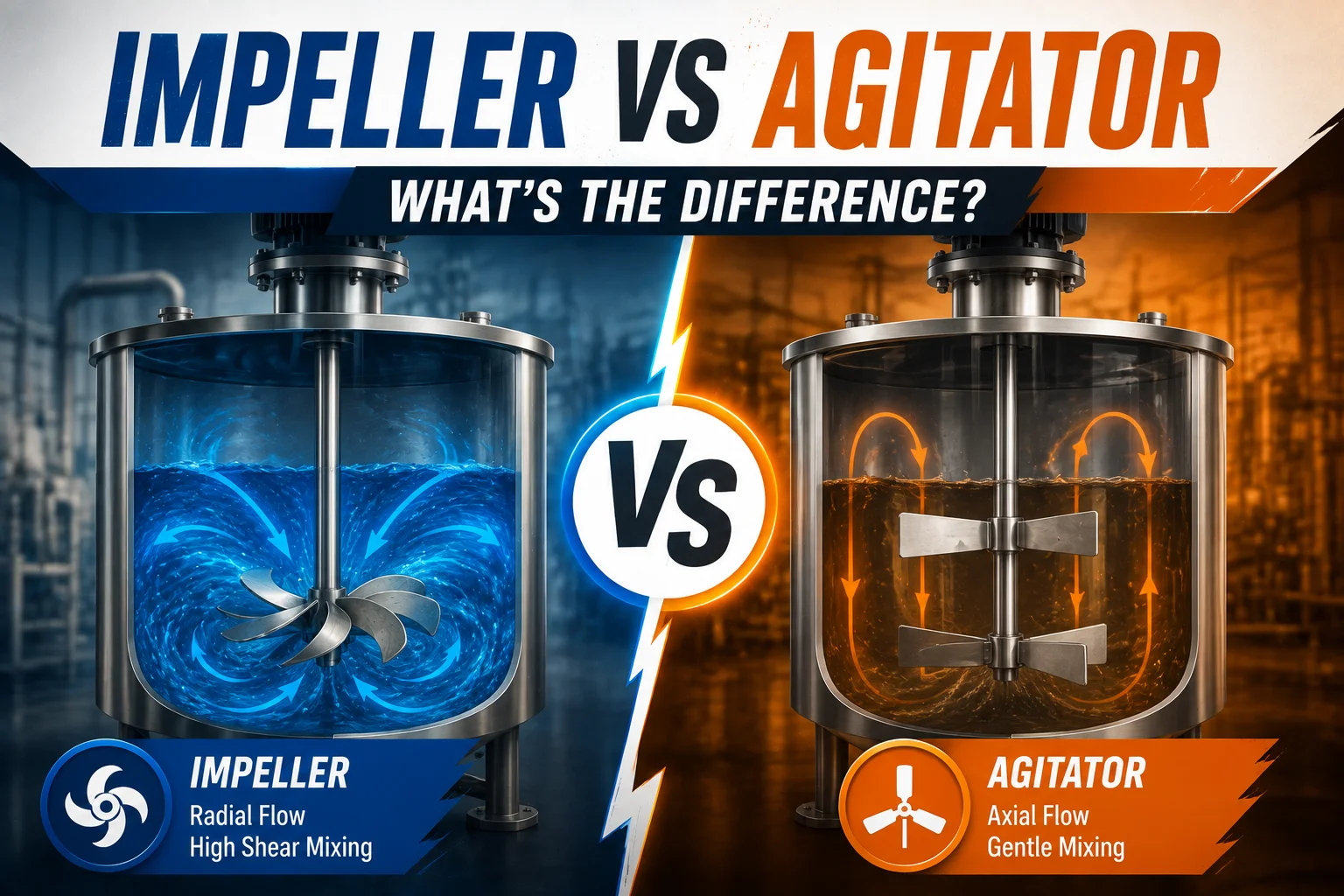
Impeller vs agitator can mean different things depending on whether you are discussing washing machines or industrial mixing equipment. In washers, they are two different mechanisms used to move clothes and water during cleaning.
An agitator is a tall central post, while an impeller is a low-profile rotating component. In industrial equipment, however, an impeller is often one part of a larger agitator system.
What Is An Agitator?
What Is A Washer Agitator?
A washer agitator is a tall spindle located in the center of a top-load washing machine. It usually has fins, vanes, or other sections designed to move clothing during the wash cycle.
The agitator moves back and forth or rotates in alternating directions. This motion creates water movement and causes clothes to rub against the agitator and each other.
That friction helps loosen dirt from fabrics. Agitator washers have been used for decades and remain popular for their familiar washing action.
How Does An Agitator Washer Work?
During a wash cycle, the central agitator moves the laundry through the water. Its motion creates mechanical action that helps separate dirt from clothing fibers.
The exact movement depends on the washer design. Some modern models use gentler motions and different cycle settings to reduce fabric wear.
Water level, detergent, load size, and cycle selection also affect cleaning performance. Therefore, the agitator itself is only one part of the washer’s overall cleaning system.
What Are The Benefits Of An Agitator?
Agitator washers can provide strong mechanical washing action. This can be useful for heavily soiled clothing, workwear, towels, and other loads that need more direct movement.
They can also offer relatively short wash cycles on some models. Their traditional design may appeal to people who prefer a familiar top-load washing experience.
The main tradeoff is that the central post takes up some space. Bulky items may therefore have less room to move around the basket.
What Is An Impeller?
What Is A Washer Impeller?
A washer impeller is a low-profile rotating component positioned at the bottom of a top-load washing machine. It can have a disc, cone, finned, or other low-profile shape.
Unlike an agitator, an impeller does not have a tall central post. This leaves more open space inside the wash basket.
The impeller rotates and creates currents within the water. Those currents move clothes around the basket and help produce friction between garments.
How Does An Impeller Washer Work?
An impeller moves water and laundry through the wash basket. The clothes move around each other rather than repeatedly being pushed against a tall central spindle.
This clothing-to-clothing movement creates friction that helps remove soil. Water currents also help distribute detergent throughout the load.
Because the center of the basket remains open, clothes have more room to move. This can be particularly useful when washing bulky items.
What Are The Benefits Of An Impeller?
Impeller washers generally provide more usable basket space. This can make them convenient for blankets, comforters, towels, and other large loads.
They also commonly use less water than traditional agitator machines. Some models can use high-speed spin cycles that remove more moisture before the clothes enter the dryer.
The lower-profile design can also provide a gentler washing experience. However, performance varies between individual models and wash cycles.
Impeller Vs Agitator: Main Difference
Design
The biggest visual difference is easy to spot. An agitator has a tall central post, while an impeller sits low at the bottom of the wash basket.
The agitator takes up some vertical space and directly interacts with clothing. The impeller leaves the center of the basket mostly open.
This difference affects how clothes move and how much usable space the washer provides.
Cleaning Action
An agitator creates mechanical movement through its central spindle. Clothing interacts with the agitator while also rubbing against other garments.
An impeller relies more heavily on water movement and clothing-to-clothing friction. The rotating component creates currents that circulate the load through the basket.
Neither system is automatically better for every type of laundry. Washer design, cycle settings, detergent, water temperature, and load size all influence cleaning results.
Capacity
An agitator occupies space in the middle of the basket. This can reduce the room available for very bulky items.
An impeller leaves more of the basket open. That can make it easier to fit larger loads and bulky fabrics.
Capacity ratings still matter more than the mechanism alone. Always check the manufacturer’s recommended load size before washing oversized items.
Impeller Vs Agitator: Quick Comparison
Side-By-Side Differences
| Feature | Agitator | Impeller |
| Location | Center of basket | Bottom of basket |
| Design | Tall spindle | Low-profile disc or cone |
| Main action | Mechanical back-and-forth movement | Rotating water movement |
| Basket space | Less open space | More open space |
| Water use | Often higher | Often lower |
| Bulky loads | Can be less convenient | Generally more convenient |
| Cleaning action | Strong direct movement | Clothing-to-clothing friction |
| Fabric action | Can be more mechanical | Generally gentler |
| Wash time | Often shorter | May be longer |
| Spin speed | Depends on model | Often high on modern models |
| Best suited to | Heavy soil and traditional washing | Bulky loads and open basket space |
These are general differences rather than guarantees. Individual washer models can vary considerably in water use, cycle length, spin speed, and cleaning performance.
Which Uses Less Water?
Impeller washers generally use less water than traditional agitator washers. Their cleaning method allows many models to operate with lower water levels while still moving the laundry effectively.
Modern high-efficiency agitator washers can also use less water than older machines. Therefore, the specific model’s water-use rating is more useful than the presence of an agitator alone.
If reducing water consumption is a priority, compare the washer’s official efficiency information. Do not assume every impeller model automatically uses less water in every cycle.
Which Uses Less Energy?
Water consumption and energy use are closely connected when a washer heats water. Using less hot water can reduce the energy required for a wash cycle.
Many impeller washers use lower water levels and can therefore have efficiency advantages. Some also use high spin speeds that remove additional moisture from clothing before drying.
However, the washer’s complete design matters. Cycle selection, water temperature, load size, and dryer usage can all affect household energy consumption.
Impeller Vs Agitator For Cleaning
Which Is Better For Heavy Dirt?
Agitators are often favored for heavily soiled clothing because they provide strong mechanical action. Work clothes and garments with ground-in dirt can benefit from this type of movement.
Impeller washers can also provide strong cleaning. Many modern models offer different wash cycles and water-level options for loads that need more intensive cleaning.
The best choice depends on the washer itself and the type of dirt involved. Pretreatment and the correct wash cycle can also make a major difference.
Which Is Gentler On Clothes?
Impeller washers generally provide less direct mechanical contact with a central spindle. Clothing moves primarily through water currents and friction between garments.
This can make an impeller appealing for people concerned about fabric wear. Still, an impeller washer can use different levels of mechanical action depending on the selected cycle.
Agitator washers are not automatically rough on clothing. Modern machines can offer gentle cycles designed for fabrics that require more careful handling.
Which Is Better For Bulky Items?
Impeller washers generally have an advantage with bulky laundry. Their open basket provides more room for comforters, blankets, towels, and other large items.
An agitator takes up space in the center of the basket. Large items may have less room to move around the spindle.
The washer’s capacity remains important in either case. A large item should only be washed if the machine is rated for its size and weight.
Impeller Vs Agitator In Industrial Mixing
Is An Impeller Part Of An Agitator?
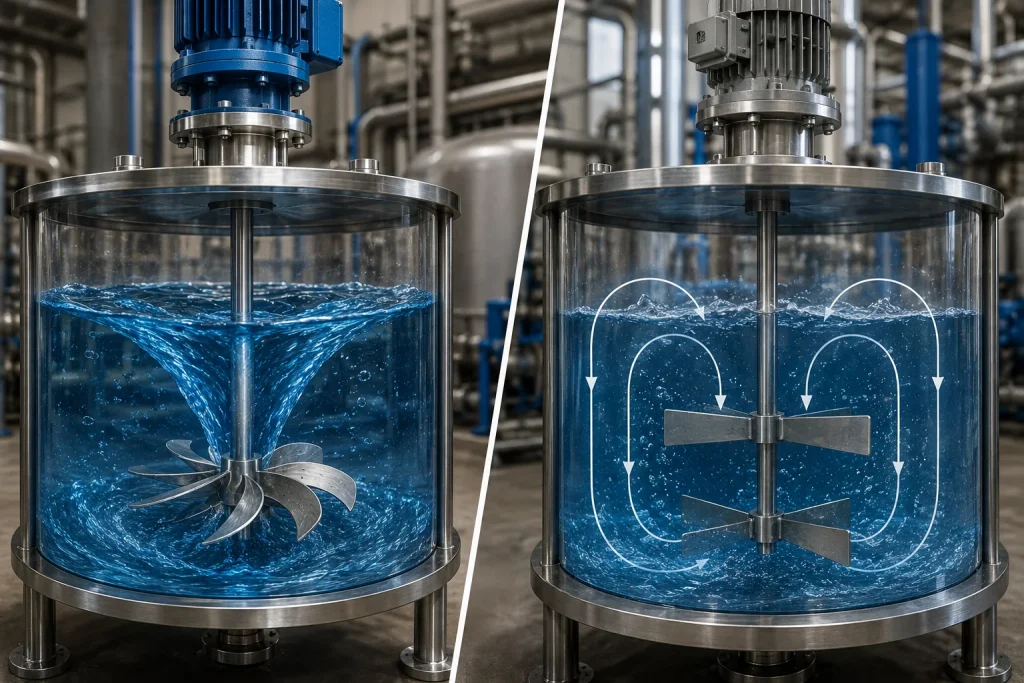
In many industrial mixing systems, yes. The impeller is mounted on a shaft and driven by the agitator’s motor and drive system.
The agitator can therefore be thought of as the larger mechanical assembly. The impeller is the rotating element that directly interacts with the material.
This relationship is different from the washer comparison. In a washing machine, agitator and impeller describe two alternative washing mechanisms.
What Is An Axial-Flow Impeller?
An axial-flow impeller moves material mainly parallel to the shaft. This type of movement is useful when strong circulation from one part of a vessel to another is needed.
Hydrofoil and propeller-style designs are common examples. Some pitched-blade turbines can also create a substantial axial flow component.
These designs are often used for blending and keeping solids suspended. Their suitability depends on the material and process conditions.
What Is A Radial-Flow Impeller?
A radial-flow impeller directs material outward from the shaft toward the tank wall. This creates a different flow pattern from axial-flow designs.
Rushton turbines are a common example of radial-flow impellers. They are associated with higher shear and can be useful in certain gas-liquid dispersion applications.
The choice between radial and axial flow depends on what the process needs. Industrial impeller selection should account for the material’s properties and the desired mixing result.
Impeller Vs Agitator: Common Confusion
Are An Impeller And Agitator The Same?
They are not always the same thing. In washing machines, they are two different wash mechanisms.
In industrial mixing, an impeller is commonly part of the larger agitator assembly. Therefore, the meaning depends on the context.
This is why a search for “impeller vs agitator” can produce apparently conflicting explanations. The terminology changes between consumer appliances and industrial equipment.
FAQs
What Is The Difference Between An Impeller And An Agitator?
In washing machines, an agitator is a tall central spindle, while an impeller is a low-profile rotating component. In industrial mixing, an impeller is often one component of a larger agitator system.
Which Cleans Better, An Agitator Or Impeller?
Neither is always better. Agitators provide strong mechanical action, while impellers use water movement and clothing-to-clothing friction.
Which Uses Less Water?
Impeller washers generally use less water than traditional agitator washers. Modern high-efficiency agitator models can also use relatively low amounts of water.
Which Is Better For Bulky Clothes?
Impeller washers are generally better suited to bulky loads because they leave more open space inside the basket. The machine’s capacity rating should still be checked.
Which Is More Energy Efficient?
Many impeller washers use less water and can have high spin speeds that reduce moisture before drying. However, the individual washer’s efficiency rating is the better comparison.
Is An Impeller The Same As An Agitator?
Not in every context. In a washer, they describe two different mechanisms, while in industrial mixing, an impeller is commonly part of an agitator assembly.
What Is A Radial-Flow Impeller?
A radial-flow impeller moves material outward from the shaft toward the vessel wall. These impellers can provide higher local shear for certain industrial applications.
Which Is Better For Heavy Dirt?
Agitator washers are often favored for heavily soiled clothing because of their strong mechanical action. However, modern impeller machines can also provide strong cleaning with the right cycle.
Which Is Better For Comforters?
An impeller washer is generally more convenient for bulky items because its basket has more open space. The washer must still have enough capacity for the particular comforter.
Is A Taper The Same As A Fade?
No. A taper and fade are different haircut styles, although both gradually shorten hair. You can learn more about the distinction in this guide to taper and fade differences.
What Is The Difference Between A Tornado Warning And Watch?
A tornado watch means conditions are favorable for tornado development, while a warning means a tornado has been detected or indicated by radar. The distinction is explained in this guide to tornado warnings and watches.
What Is An Impeller Used For?
An impeller can move water and clothing in a washing machine or create fluid movement in industrial mixing equipment. Its exact function depends on the equipment in which it is installed.
Final Takeaways
The meaning of impeller vs agitator depends on the context. In washing machines, an agitator is a tall central post that moves clothing directly, while an impeller is a low-profile component that creates water currents. Impeller washers generally offer more open basket space and often use less water, while agitator washers are known for strong mechanical cleaning action.
An agitator can be a good choice for heavily soiled clothing and people who prefer traditional washing action. An impeller may be better for bulky loads, larger usable basket space, and potentially gentler fabric movement. Neither design is automatically better, so capacity, water use, cycle time, spin speed, and the washer’s specific features should also be considered.
In industrial mixing, the terminology has a different meaning. An agitator usually refers to the larger mechanical mixing assembly, while the impeller is the rotating component that creates flow inside the vessel. Understanding this context prevents confusion and makes the basic difference easy to remember: washer agitators and impellers are competing wash mechanisms, while industrial impellers are commonly components of agitator systems.
